
Smuggle bytes through the air — Security-focused QR code encryption
Meow Decoder lets you securely transfer files between air-gapped computers using only a phone camera as a dumb optical bridge — animated QR codes carry AES-256-GCM encrypted data with forward secrecy, post-quantum protection, and experimental deniability features.
Why choose this? Unlike basic QR exfil tools, Meow Decoder adds strong authenticated encryption, forward secrecy, and post-quantum options. It includes experimental deniability and duress features that may reduce risk under casual inspection, but may be detectable under advanced forensic analysis. Not suitable for nation-state adversaries without additional operational security measures.




| ✅ This IS for you if... | ❌ This is NOT for you if... |
|---|---|
| You're a developer/researcher | You want a consumer mobile app |
| You need air-gapped file transfer | You want one-tap phone scanning |
| You understand command-line tools | You need plug-and-play simplicity |
| You want to audit the crypto yourself | You need production enterprise support |
⚖️ Legal Notice: Meow Decoder is not intended to circumvent law enforcement or legal obligations. Steganography and deniability features are limited and detectable under forensic examination.
📜 Intended Use: Designed for legal privacy needs, such as journalist-source protection under First Amendment or equivalent laws. Not for illegal activities. Consult legal experts if uncertain about your jurisdiction.
Honest disclaimer: This is a developer/research tool. It requires Python, command-line comfort, and understanding of what you're doing.
Meow Capture — A secure offline QR capture companion app for air-gapped file transfer.
Point your phone at the animated QR code on your screen and let Meow Capture handle the rest — no network, no cloud, no traces.
Google Play Store listing coming soon.
-
On your Android phone, go to Settings → Apps → Special app access → Install unknown apps and allow your browser.
-
Open this link on your phone and tap Download:
-
Open the downloaded
.apkfile and tap Install. -
Launch Meow Capture — grant camera permission when prompted.
The iOS version is under active development. Apple App Store listing coming soon. In the meantime, iOS users can scan QR codes via the web demo in Safari.
| Platform | Status |
|---|---|
| Android (sideload) | ✅ Available now — download APK above |
| Google Play Store | 🔜 Coming soon |
| iOS App Store | 🔜 Coming soon |
| Feature | Detail |
|---|---|
| Scanner | VisionCamera v4 (MLKit / AVFoundation) |
| Security mode | Strict (wipe on background) or Convenience |
| Export | Biometric-gated JSON → Downloads, ADB pull, SHA-256 verify |
| Live coaching | Decode rate, duplicate rate, shake, exposure bias hints |
| Preflight | Calibration Wizard (5-step camera readiness check) |
| Diagnostics | Hidden long-press panel — JS lag, heap, thermal, FPS |
| Import | Scan Request QR from sender screen — no JSON file needed |
| Multi-device | meow-decoder merge CLI combines two-phone captures |
| Tests | 267 passing, ≥95 % coverage, zero network permissions |
The Problem: You need to move a file between two computers that can't touch the network (air-gapped, hostile network, zero-trust).
The Solution: Turn the file into animated QR codes, display on screen, record with any camera, decode on the other side.
Sender: secret.pdf → meow-encode → Animated QR GIF
                                       ↓ (phone camera)
                                    Video File
                                       ↓ (transfer)
Receiver: Video → meow-decode → secret.pdf (recovered)
That's it. The phone is just a dumb optical sensor. All crypto happens on trusted computers.
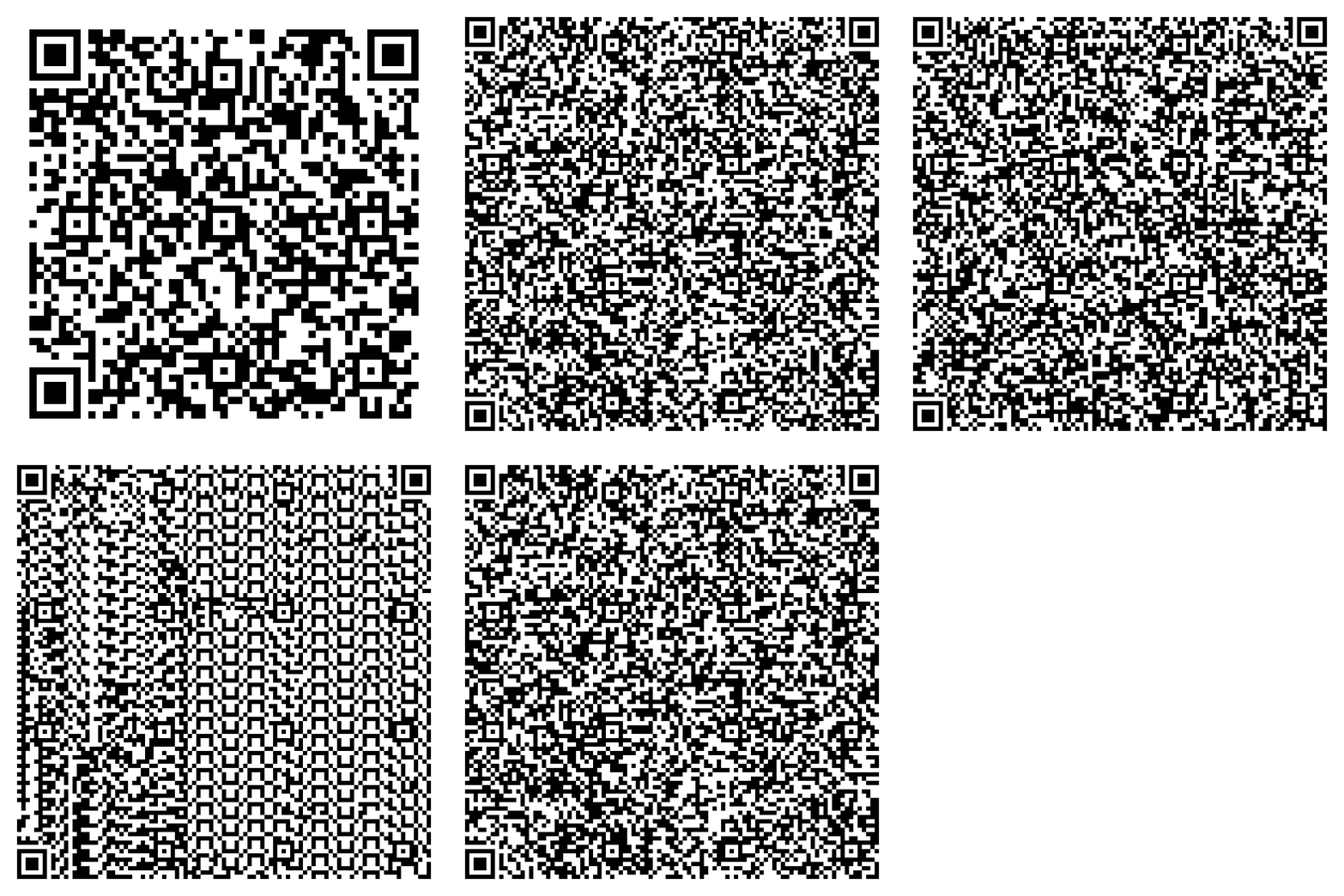
This demo shows the explicit mechanics of Meow Decoder. QR codes are intentionally visible so first-time users can clearly understand what is happening.
The demo GIF contains a real encrypted message you can decode:
| Demo File | Description | Download |
|---|---|---|
demo.gif |
Standard QR animation | Download |
Password: JesusIsTheSonOfGod
# Download and decode the demo
curl -O https://raw.githubusercontent.com/systemslibrarian/meow-decoder/main/assets/demo.gif
meow-decode-gif -i demo.gif -o message.txt -p "JesusIsTheSonOfGod"
cat message.txt
Hidden message: John 3:16 (KJV) - "For God so loved the world..."
pip install meow-decoderOr from source:
git clone https://github.com/systemslibrarian/meow-decoder.git
cd meow-decoder
pip install -e .# Sender: Encrypt file into animated QR GIF
meow-encode -i secret.pdf -o secret.gif -p "YourStrongPassword123"
# Receiver: Decrypt from video recording
meow-decode-gif -i captured_video.mp4 -o recovered.pdf -p "YourStrongPassword123"📹 Recording & Transfer Details
Display the GIF:
open secret.gif      # macOS
xdg-open secret.gif  # Linux
start secret.gif     # Windows
Record: Point your phone camera at the screen for 10-15 seconds (GIF loops automatically).
Transfer: Move the video to the receiving computer via USB, email, or cloud. The video is encrypted garbage without the password.
Decode: Run meow-decode-gif as shown above.
Done! File recovered with integrity verification.
| Feature | Description |
|---|---|
| 🔒 AES-256-GCM | Military-grade authenticated encryption |
| 🔑 Argon2id | Memory-hard KDF (512 MiB, 20 iterations) |
| 📱 Air-Gap Friendly | Transfer via any camera, no network needed |
| 🛡️ Forward Secrecy | X25519 ephemeral keys (DEFAULT) |
| 🐈⬛ Schrödinger Mode | Dual-secret plausible deniability |
| 🔮 Post-Quantum | ML-KEM-768 (default, Signal PQXDH) / ML-KEM-1024 (paranoid) + ML-DSA-65 hybrid |
| 📊 Fountain Codes | Tolerates 33% frame loss in multi-frame QR (Python + JavaScript) |
| 🔐 Duress Mode | Panic password triggers secure wipe |
| 🖥️ Hardware Keys | HSM/PKCS#11, YubiKey PIV/FIDO2, TPM 2.0 PCR binding (--yubikey, --hsm-slot, --tpm-seal) |
| 📊 Tamper Report | Frame-by-frame MAC timeline with cluster detection |
| 📱 Mobile Bridge | React Native QR scanner app with JSON protocol integration |
| 🌐 WASM Target | Browser crypto demo available (make build-wasm, see examples/) |
| 🎨 Multi-Layer Stego | Six-channel steganography (LSB+STC, timing, palette, disposal, comment, temporal) for camouflage; not guaranteed against state-grade steganalysis (audit, evaluation) |
Want the GIF to look innocent instead of obvious QR codes? Use your own cat photos!
Hide your encrypted QR codes inside your own images (cat photos recommended!):
# Hide in a single cat photo (cycles through frames)
meow-encode -i secret.pdf -o cats.gif --stego-level 3 --carrier my_cat.jpg

# Hide in multiple photos (uses each in sequence)
meow-encode -i secret.pdf -o vacation.gif --stego-level 2 --carrier photo1.jpg photo2.jpg photo3.jpg

# Use a glob pattern for all your cat photos
meow-encode -i secret.pdf -o cats.gif --stego-level 3 --carrier ~/Pictures/cats/*.jpg

# Maximum stealth mode (paranoid level + obfuscation)
meow-encode -i secret.pdf -o innocent.gif --stego-level 4 --carrier *.png| Level | Name | Description |
|---|---|---|
| 0 | Off | Plain QR codes (default) |
| 1 | Visible | 3-bit LSB, high capacity, visible under analysis |
| 2 | Subtle | 2-bit LSB, balanced (recommended) |
| 3 | Hidden | 1-bit LSB, nearly invisible |
| 4 | Paranoid | 1-bit LSB + noise obfuscation |
Restricts LSB embedding to green-dominant pixels only (e.g., cat eyes, logo waves).
# Embed only in green regions of carrier image
meow-encode -i secret.pdf -o logo.gif -p "password" \
--stego-level 3 --carrier assets/meow-decoder-logo.png --stego-green- Cosmetic only — reduces visible artifacts but does NOT defeat steganalysis
- Reduced capacity — only ~10-30% of pixels are modifiable
- Requires
--carrier— must provide carrier image(s) with green regions - Still detectable — chi-square analysis will find the embedded data
Best for: Making embedded QR codes less visually obvious in specific regions. NOT for: Evading forensic detection or professional steganalysis.
Encodes two completely separate secrets into one GIF. Each password reveals a different reality:
# Encode two secrets with dual-secret deniability
meow-schrodinger-encode \
    --real secret_plans.pdf \
    --decoy vacation_photos.zip \
    --real-password "ActualSecret123" \
    --decoy-password "InnocentPassword" \
-o quantum.gif| Password Entered | What You Get |
|---|---|
ActualSecret123 |
Your real secret file |
InnocentPassword |
Innocent decoy content |
| Wrong password | Decryption fails normally |
⚠️ Honest Security Assessment:Schrödinger mode attempts to encode two independent secrets into one output file. Revealing one password shows a plausible complete payload (decoy or real). Cryptographic deniability is limited: while the two encodings are designed to look superficially similar, advanced statistical analysis, timing differences, or comparison of multiple files from the same user may allow a nation-state forensic team to detect the presence of dual encoding or link transfers. This is plausible deniability under casual inspection, not perfect cryptographic deniability against unlimited compute and multiple samples. Duress/panic password triggers decoy reveal + key wipe, but memory/swap/forensic recovery may still expose keys if not done perfectly. Do not rely on this feature alone against a determined state adversary.
See also: THREAT_MODEL.md for the full plausible deniability security analysis.
✅ Status: Fully Implemented
A "distress signal" password that appears to work normally but secretly:
- Shows innocent decoy content (looks like a real decryption)
- Silently wipes all encryption keys from memory
- Optionally triggers secure deletion of key material
- Leaves no trace that a real secret existed
How to use:
# During encoding - set up both passwords
meow-encode \
    -i secret.pdf \
    -o secret.gif \
    --password "RealPassword123" \
    --duress-password "GiveThisToAttacker"

# During decoding - either password "works"
meow-decode-gif -i secret.gif -o output.pdf -p "RealPassword123"     # Real secret
meow-decode-gif -i secret.gif -o output.pdf -p "GiveThisToAttacker"  # Decoy + wipe
If coerced: Enter the duress password. The attacker sees decoy content, your keys are wiped, and there's no evidence of the real secret.
| Feature | Schrödinger Mode | Duress Mode |
|---|---|---|
| Purpose | Limited plausible deniability | Emergency key destruction |
| Two secrets? | ✅ Yes, both recoverable | ❌ Real secret destroyed |
| Attacker sees | Valid decoy content | Valid decoy content |
| Keys after | Both intact | Wiped from memory |
| Best for | Casual inspection cover | Physical coercion |
Meow Decoder intentionally does not require a mobile app.
- Phones are untrusted — treat them as dumb optical sensors
- No app = no attack surface — nothing to exploit on the phone
- Works with any camera — phone, webcam, DSLR, whatever
- All crypto on trusted machines — you control the endpoints
- Display the animated GIF on any screen
- Record the looping animation with a phone camera
- Transfer the video/photos to a computer
- Decode on the computer using the passphrase
Similar projects discovered after development began:
| Project | Description | What We Learned |
|---|---|---|
| TXQR | Transfer via QR - Protocol for animated QR data transfer using fountain codes | Fountain code mechanics for error correction |
| BitFountain | Experimental data transceiver using QR codes between devices | Camera-to-camera interaction concepts |
| QRExfil | Convert binary files to QR GIFs for air-gapped exfiltration | Demonstrated DLP bypass risks via optical channels |
| QRFileTransfer | Cross-platform offline file transfer using only camera streams | Platform-agnostic optical transfer |
Compared to these projects, Meow Decoder adds critical security features:
- 🔐 Authenticated Encryption — AES-256-GCM with HMAC (not just encoding)
- 🔮 Post-Quantum Ready — ML-KEM-768 (default) / ML-KEM-1024 (paranoid) PQXDH hybrid cryptography
- 🌊 Loss-Tolerant — Fountain codes reconstruct from any ~1.5× k frames
- 🛡️ Threat Modeled — Explicit adversarial analysis (THREAT_MODEL.md)
- ⚛️ Plausible Deniability — Schrödinger mode with dual-secret encoding
- 🔑 Forward Secrecy — X25519 ephemeral keys protect past messages
- 🧠 Memory Hardening — mlockall, RLIMIT_CORE=0, PR_SET_DUMPABLE, MADV_DONTDUMP
- 🧹 Forensic Countermeasures — Thumbnail/clipboard/history cleanup, tmpfs enforcement, secure delete
- ⏱️ Timing Equalization — Constant wall-clock decode, forced dual-path, CSPRNG jitter
- 📐 Size Normalization — Power-of-4 padding classes prevent file size fingerprinting
- 💀 Timed Expiry — Self-destructing content with configurable TTL
- 🔒 Fixed QR Version — Prevents payload size leakage via QR structure
- 🎲 Inter-File Decorrelation — Randomized encoding parameters prevent profiling
- 🌐 Air-Gap Verification — Network/WiFi/Bluetooth/DNS detection checks
Below the fur: the sections that follow are for developers, security researchers, and contributors who want to understand how the cat's claws actually work.
File → Compress → Encrypt → Fountain Encode (Luby Transform) → QR Codes → Animated GIF

**Multi-Frame Frame Loss Tolerance:** Payloads >2500 bytes use fountain codes (rateless erasure coding) that allow decoding from ANY ~67% of frames. This solves the "missed frame" problem in phone camera capture—autofocus lag, motion blur, and low framerates no longer cause decoding failure. Works in both Python CLI and JavaScript web demo.
| Step | What Happens |
|---|---|
| 1. Compress | Your file is compressed with zlib to reduce size |
| 2. Encrypt | AES-256-GCM encryption with Argon2id key derivation |
| 3. Fountain Encode | Encrypted data split into redundant "droplets" using Luby Transform codes |
| 4. QR Generation | Each droplet (~500 bytes) becomes a QR code frame |
| 5. GIF Assembly | Frame 0 = manifest (metadata), Frames 1+ = data droplets |
Fountain codes are "rateless" - you can generate infinite droplets, and you only need ~67% of them to reconstruct the original data. This means:
- 📱 Shaky phone video? No problem
- 🔄 Missed some frames? Keep going
- 🌫️ Blurry QR codes? Skip them, decode others
- ♾️ GIF loops forever, giving multiple chances to capture each frame
┌─────────────┐         ┌─────────────┐         ┌─────────────┐
│   SENDER    │  light  │   PHONE     │  file   │  RECEIVER   │
│   SCREEN    │ ──────► │   CAMERA    │ ──────► │   DECODE    │
│  (GIF plays)│         │ (records)   │         │ (extracts)  │
└─────────────┘         └─────────────┘         └─────────────┘
      │                                               │
      └───────── NO NETWORK CONNECTION ───────────────┘
The phone is just a "dumb" optical sensor carrying photons. It never decrypts anything - all crypto happens on trusted computers at each end.
- Extract frames from GIF or video file
- Scan QR codes from each frame
- Collect droplets (fountain codes handle missing/corrupted frames)
- Reconstruct encrypted blob when enough droplets collected
- Decrypt with your password (Argon2id → AES-256-GCM)
- Decompress → original file restored
| Threat | How |
|---|---|
| Network eavesdropping | Data never touches a network |
| Man-in-the-middle | Optical channel, no network routing |
| Brute force attacks | Argon2id (512 MiB, 20 iterations) |
| Tampering/modification | AES-GCM authentication + HMAC |
| Future password compromise | Forward secrecy (X25519 ephemeral keys) |
| Coercion ("give me the password") | Schrödinger mode (plausible deniability) |
| Dropped/corrupted frames | Fountain codes (33% loss tolerance) — Python + JS implementation |
| Quantum computers (future) | Post-quantum crypto (ML-KEM-768 default / ML-KEM-1024 paranoid, with receiver PQ public key) |
| Threat | Why |
|---|---|
| Shoulder surfing | Someone watching your screen sees the GIF |
| Compromised endpoint | Malware on sender/receiver defeats everything |
| Keyloggers | Password stolen before encryption |
| Physical coercion (torture) | No crypto defeats rubber-hose cryptanalysis |
| Screen recording malware | Same as shoulder surfing, automated |
| State-level adversaries | No formal audit; use certified tools for classified data |
Five layers, from Rust primitives at the bottom to cat puns at the top. The deeper you go, the more serious things get.
┌─────────────────────────────────────────────────────────────────┐
│                    ENCODING PIPELINE                            │
├─────────────────────────────────────────────────────────────────┤
│                                                                 │
│  File → Compress → Encrypt → Fountain Code → QR Frames → GIF   │
│          (zlib)   (AES-GCM)  (Luby Transform)  (qrcode)  (PIL)  │
│                                                                 │
├─────────────────────────────────────────────────────────────────┤
│                    DECODING PIPELINE                            │
├─────────────────────────────────────────────────────────────────┤
│                                                                 │
│  GIF/Video → Extract Frames → Read QR → Fountain Decode →      │
│              (PIL/OpenCV)    (pyzbar)   (Belief Prop)           │
│                                                                 │
│           → Decrypt → Decompress → Verify Hash → File          │
│             (AES-GCM)   (zlib)     (SHA-256)                    │
│                                                                 │
└─────────────────────────────────────────────────────────────────┘
Crypto Stack:
- Encryption: AES-256-GCM (authenticated)
- Key Derivation: Argon2id (512 MiB memory, 20 iterations)
- Forward Secrecy: X25519 ECDH (DEFAULT ON)
- Per-Frame Ratchet: Signal-inspired symmetric ratchet (MSR v1.2) with header encryption and key commitment
- Post-Quantum: ML-KEM-768 + X25519 PQXDH (default) / ML-KEM-1024 (paranoid), requires receiver PQ public key
- Signatures: ML-DSA-65 + Ed25519 hybrid (manifest auth)
- Integrity: HMAC-SHA256 + per-frame MACs + key commitment tags
- Error Correction: Luby Transform fountain codes
For full details: Architecture Documentation
MEOW_MANIFEST_SIGNING=off at your own risk. Always use signing for production/high-risk use.
The playful exterior is backed by real cryptographic guarantees. Here's what the cat is actually made of.
| Property | Implementation | Status |
|---|---|---|
| Authenticated Encryption | AES-256-GCM | ✅ |
| Memory-Hard KDF | Argon2id (512 MiB, 20 iter) | ✅ |
| Tamper Detection | GCM tags + HMAC + frame MACs | ✅ |
| Forward Secrecy | X25519 ephemeral keys | ✅ Default |
| Per-Frame Forward Secrecy | Symmetric ratchet (MSR v1.2) | ✅ Optional |
| Header Encryption | HKDF-XOR masked frame indices | ✅ |
| Key Commitment | HMAC-SHA256 commitment tags | ✅ |
| Post-Quantum | ML-KEM-768/1024 + ML-DSA-65 | ✅ Default (768) / Paranoid (1024) |
| Plausible Deniability | Schrödinger dual-secret | ✅ Optional |
| Coercion Resistance | Duress passwords | ✅ |
| Error Recovery | Fountain codes (33% loss OK) | ✅ |
| Constant-Time Ops | Rust crypto backend | ✅ |
| Tamper Timeline | Frame-by-frame MAC report | ✅ |
| Security Tests | 2400+ Python + 800+ Rust tests, CI-enforced (3-gate) | ✅ |
Full threat model: THREAT_MODEL.md
🔒 All secret-handling cryptography now lives in the Rust core (crypto_core). The cat may look playful — but the claws are constant-time.
The Rust cryptographic backend is mandatory for secure operation.
| Property | Rust Backend |
|---|---|
| Constant-time operations | ✅ Guaranteed (subtle crate) |
| Memory zeroing | ✅ Automatic (zeroize crate) |
| Side-channel resistance | ✅ Audited crates |
| Performance | ~2x faster |
🧠 What the Rust migration actually changes (and what it doesn't)
The move to Rust does not upgrade AES-256-GCM, X25519, HKDF, Argon2id, or ML-KEM. The math is identical — if AES-256 was 256-bit secure before, it still is.
What it improves is the implementation layer:
- Memory safety — Rust's
zeroizecrate wipes secrets on drop. Python's garbage collector makes no such guarantee, leaving key material lingering in memory. - Secret boundary clarity — Python now handles orchestration only; Rust owns the cryptographic boundary. Cleaner to audit, harder to accidentally leak secrets.
- Constant-time discipline — The
subtlecrate enforces timing-safe comparisons at the type level, not by convention. - Auditability — A compact Rust core is easier for external reviewers to read than crypto scattered across Python modules.
- No silent fallbacks — If the Rust backend is missing, the system fails closed. CI enforces this. No "works locally but insecure in production" surprises.
Honest summary: Strong protocol before, strong protocol after. The difference is lower implementation risk, cleaner secret hygiene, and a crypto boundary you can actually audit.
See Architecture docs for the full analysis.
# 1. Install Rust (if not already installed)
curl --proto '=https' --tlsv1.2 -sSf https://sh.rustup.rs | sh
source $HOME/.cargo/env

# 2. Install maturin (Python ↔ Rust build tool)
pip install maturin

# 3. Build and install the Rust module
cd rust_crypto
maturin develop --release
cd ..

# 4. Verify installation
python -c "import meow_crypto_rs; print('✅ Rust backend:', meow_crypto_rs.backend_info())"The encoder/decoder uses the Rust backend by default once installed.
No production Python module imports the cryptography library — all crypto primitives (AES-GCM, HKDF, X25519, Argon2id) route through the Rust backend via crypto_backend.CryptoBackend(). This is enforced by an AST-based CI test (tests/test_crypto_enforcement.py).
Non-production modules (
spec_v12/,experimental/) are quarantined and excluded from the enforcement scan. See Architecture docs for details.
Benchmarks (Typical):
- Key Derivation (Argon2id): Rust is ~30% faster
- Encryption (AES-GCM): Rust is ~2x faster
- Security: Rust backend uses the
subtlecrate for verified constant-time comparisons.
Current status: Primitives are fully implemented in the Rust crypto core. CLI flags (
--yubikey,--hsm-slot,--tpm-seal) are available; full end-to-end integration is in final testing.
Meow Decoder supports hardware-backed key storage for high-security environments.
| Device | CLI Flag | Description |
|---|---|---|
| HSM/PKCS#11 | --hsm-slot <slot> |
Enterprise HSMs (Thales, Utimaco, SoftHSM) |
| YubiKey | --yubikey --yubikey-slot <9a|9c|9d|9e> |
PIV slots for key storage |
| TPM 2.0 | --tpm-seal <0-23> |
Platform-bound keys with PCR sealing |
# Encode with YubiKey (PIV slot 9a = authentication)
meow-encode -i secret.pdf -o secret.gif --yubikey --yubikey-slot 9a

# Encode with HSM (slot 0)
meow-encode -i secret.pdf -o secret.gif --hsm-slot 0

# Encode with TPM (bind to PCR 7 = Secure Boot state)
meow-encode -i secret.pdf -o secret.gif --tpm-seal 7

# Decode requires the same hardware present
meow-decode-gif -i secret.gif -o recovered.pdf --yubikey --yubikey-slot 9a- Key Generation: Hardware generates a non-exportable key pair
- Key Wrapping: AES-256 content key is wrapped by hardware public key
- Wrapped Key in Manifest: GIF manifest stores the wrapped key blob
- Decryption: Hardware unwraps the content key; plaintext key never leaves the device
Security Properties:
- Private keys never leave the hardware — resistant to memory dumps
- TPM PCR binding ensures decryption only on specific boot configurations
- YubiKey requires physical touch for each operation (anti-malware)
See crypto_core/README.md for Rust API details and advanced configuration.
Current status: Prototype implementation available. Basic registration and key derivation working. Full integration with WASM demo in progress.
The browser demo now supports WebAuthn/FIDO2 hardware security keys for hardware-backed encryption:
import { HardwareKeyManager } from './webauthn-hardware.js';

const hwManager = new HardwareKeyManager();

// Register a security key (YubiKey, Titan, etc.)
await hwManager.register("my-username");

// Derive encryption key with hybrid security:
// - Password (knowledge factor)
// - Hardware key signature (possession factor + touch)
const key = await hwManager.deriveKey(password, salt, argon2DeriveFunc);
Security Model:
- 🔐 Key Isolation: Private keys never leave the hardware authenticator
- 👆 Touch Required: Physical presence verification for each operation
- 🔑 Hybrid Derivation: XORs hardware signature with Argon2id password key
- 🛡️ Multi-Factor: Combines knowledge (password) + possession (key) + presence (touch)
Supported Keys:
- YubiKey 5 Series (FIDO2)
- Google Titan Security Key
- Windows Hello (platform authenticator)
- Any FIDO2/WebAuthn compatible device
Implementation Files:
examples/webauthn-hardware.js— Core WebAuthn integrationtests/test_webauthn_integration.html— Browser-based unit tests
See the examples/ directory for full setup instructions.
Current status: Production-ready. 267 passing tests, Vision Camera v4 frame processor, full state machine (
IDLE → CAPTURING → COMPLETE), Zod-validated protocol, chunked JSON export. Seemobile/README.mdfor setup.
The React Native QR scanner app provides a seamless mobile-to-CLI workflow for capturing animated QR codes.
# iOS
cd mobile && npx pod-install && npx react-native run-ios

# Android
cd mobile && npx react-native run-androidThe mobile app communicates with the CLI via JSON over stdout/stdin or file exchange:
Capture Request (CLI → App):
{
  "action": "capture",
  "session_id": "uuid-v4",
  "expected_frames": 45,
  "timeout_seconds": 60
}
Frame Data (App → CLI):
{
  "session_id": "uuid-v4",
  "frames": [
    {"index": 0, "data": "base64...", "timestamp_ms": 1234567890},
    {"index": 1, "data": "base64...", "timestamp_ms": 1234567950}
  ],
  "capture_complete": true,
  "frames_captured": 45,
  "frames_missed": 2
}
Decode Response (CLI → App):
{
  "session_id": "uuid-v4",
  "status": "success",
  "output_file": "/path/to/recovered.pdf",
  "integrity_verified": true,
  "frames_used": 43
}# Export capture request for mobile app
meow-decode-gif --mobile-bridge --output-request capture_request.json
# Import captured frames from mobile
meow-decode-gif --mobile-bridge --input-frames captured_frames.json -o recovered.pdf -p "password"
# Or use pipe mode (adb/USB bridge)
adb shell cat /sdcard/meow_frames.json | meow-decode-gif --mobile-bridge -o recovered.pdf -p "password"See mobile/ARCHITECTURE.md for full protocol specification and app architecture.
Run the crypto core directly in your browser — no server-side processing, fully client-side encryption.
| Feature | CLI (Python) | Web Demo (WASM) | Notes |
|---|---|---|---|
| AES-256-GCM | ✅ | ✅ | Identical AEAD |
| Argon2id KDF | ✅ 512 MiB/20 iter | ✅ Configurable | Web: 64-512 MiB selectable |
| X25519 Forward Secrecy | ✅ | ✅ | Full parity |
| ML-KEM-768/1024 Post-Quantum | ✅ | ✅ | Requires --features wasm-pq |
| Schrödinger Mode | ✅ | ✅ | Dual-secret deniability |
| Fountain Codes | ✅ | ✅ | Full support (Python + JavaScript, 33% frame loss tolerance) |
| GIF Animation | ✅ | ✅ | Multi-frame QR with fountain codes (loss-tolerant) |
| Steganography | ✅ Level 0-4 | Browser canvas limitations | |
| Hardware Keys | ✅ | 🔬 Prototype | WebAuthn/FIDO2 implementation available (webauthn-hardware.js) |
| Webcam Decode | ✅ | ✅ | Real-time camera scanner |
| Duress Mode | ✅ | ✅ | Panic password wipe |
| File Upload | ✅ | ✅ | Up to ~2KB per QR |
The web demo provides 4 security levels to balance speed vs. brute-force resistance:
| Level | Memory | Iterations | Time | Use Case |
|---|---|---|---|---|
| ⚡ Fast | 64 MiB | 3 | ~1 sec | Quick demos, low-value data |
| 🔒 Standard | 128 MiB | 8 | ~3 sec | General use |
| 🛡️ High | 256 MiB | 15 | ~8 sec | Sensitive data |
| 🔐 Paranoid | 512 MiB | 20 | ~20 sec | Matches CLI — life-critical |
- Rust (stable toolchain via rustup)
- wasm-pack:
cargo install wasm-pack - HTTP server: Python's built-in works, or
npm install -g serve
# Standard build (X25519 + AES-256-GCM)
make build-wasm

# With Post-Quantum ML-KEM-768/1024 support
wasm-pack build crypto_core --target web --release --features wasm-pq
This creates crypto_core/pkg/ with the .js and .wasm files.
# One command: build WASM + start server
make meow-build

# Then open: http://localhost:8080/examples/wasm_browser_example.html
Or manually:
# Build first (if not already done)
make build-wasm

# Start HTTP server from project root
python3 -m http.server 8080

# Open in browser:
# http://localhost:8080/examples/wasm_browser_example.htmlThis repo includes a .devcontainer/devcontainer.json for GitHub Codespaces and VS Code Dev Containers.
Port Forwarding is Disabled by Default — This prevents confusing "Cannot GET /" errors and popup spam when opening a Codespace. When you're ready to run the WASM demo:
- Run:
make meow-build - Open the Ports tab (bottom panel)
- Forward port 8080 (will auto-detect or right-click → Forward Port)
- Click the forwarded URL, then navigate to
/examples/wasm_browser_example.html
| Scenario | Action |
|---|---|
| First clone | Run make meow-build (~1-2 min to build, then serves) |
| Resume/reopen | Built files persist — just make meow-build starts server |
| Container rebuild | Re-run make meow-build |
| Rust code changes | Re-run to pick up changes |
Why a server? Browsers block WASM loading from
file://URLs. The HTTP server provides proper MIME types for.wasmfiles.
See the examples/ directory for full details.
# Install dev dependencies
pip install -e ".[dev]"

# Run all tests
pytest tests/

# Run security tests specifically
pytest tests/test_security.py tests/test_adversarial.py

# Run by marker (strict markers enforced)
pytest -m security          # Security-critical tests
pytest -m crypto            # Crypto unit tests
pytest -m "not slow"        # Skip slow tests (used in CI Gate 1)

# Run property-based tests (security invariants)
pytest tests/test_property_based.py -v --hypothesis-show-statistics

# Run with coverage
pytest --cov=meow_decoder tests/

# Self-test (verifies backend, roundtrip, fountain codec)
meow-encode --self-test

### Property-Based Testing

We use **Hypothesis** for property-based testing to verify security invariants hold for all possible inputs:

```bash
# Run with detailed statistics
pytest tests/test_property_based.py -v --hypothesis-show-statistics

# Run exhaustive profile (1000 examples per test)
pytest tests/test_property_based.py --hypothesis-profile=exhaustive
Key invariants tested:
- Encrypt/Decrypt Roundtrip:
decrypt(encrypt(x)) == xfor all x - Tamper Detection: Any bit flip in ciphertext is detected
- Nonce Uniqueness: Same key never reuses nonce
See docs/SECURITY_INVARIANTS.md for the complete invariant specification.
CI runs on Python 3.10–3.12 with CodeQL and security scanning.
We use AFL++ with Python bindings (atheris) to test robustness against malformed inputs.
For the full test inventory and coverage tracking, see tests/TEST_SUITE_README.md.
- Manifest Parsing: Tests against malformed binary structures
- Crypto Operations: Tests error handling in key derivation/decryption
- Fountain Codes: Tests droplet parsing logic
-
Install Atheris:
pip install atheris
-
Run a Fuzzer:
# Fuzz manifest parsing logic
python3 fuzz/fuzz_manifest.py

# Fuzz crypto operations
python3 fuzz/fuzz_crypto.py
Findings:
- Fuzzing results are not claimed without a recorded run log.
- Continuous fuzzing is recommended before major releases.
See fuzz/README.md for details.
Formal methods live in formal/README.md. Quick commands:
# One-command verification
make verify

# ProVerif (symbolic protocol analysis)
cd /workspaces/meow-decoder/formal/proverif
eval $(opam env)
proverif meow_encode.pv

# TLA+ (state machine model checking)
cd /workspaces/meow-decoder/formal/tla
java -jar tla2tools.jar -config MeowEncode.cfg MeowEncode.tla

# Verus (Rust proofs — guard-page memory safety only)
cd /workspaces/meow-decoder/crypto_core
verus src/lib.rs

# Tamarin (observational equivalence, optional)
cd /workspaces/meow-decoder/formal/tamarin
./run.sh
More details and expected results:
Scope: These methods verify protocol and wrapper invariants, not AES‑GCM itself or side‑channel resistance. Tamarin is optional but required for a full local make verify; CI skips it unless installed.
Verus proof status (honest assessment):
Proof set File Status Guard-page memory safety (GB-001 – GB-008) verus_guarded_buffer.rs✅ Real Verus proofs — bounds, overflow/underflow, zeroize-on-drop AEAD properties (AEAD-001 – AEAD-004) verus_proofs.rs⚠️ Proof stubs only — structured as doc-comment specifications, not machine-checked Verus proofs. Properties are enforced by Rust's type system (UniqueNonce,AuthenticatedPlaintext), runtime tests, and thezeroizecrate — not by Verus.We do not claim formally verified AEAD. The AEAD wrapper's correctness rests on the
aes-gcmcrate's proven security, Rust's ownership system, and comprehensive testing.
| Adversary | Can Meow Decoder Stop Them? (No Guarantees) |
|---|---|
| Script kiddie | ✅ Yes, easily |
| Skilled hacker (network) | ✅ Yes (no network exposure) |
| Corporate IT snooping | ✅ Yes (optical bypasses monitoring) |
| Law enforcement (legal demand) | ❌ Not designed for this |
| Intelligence agency | ❌ Not designed for this |
| NSA with full resources | ❌ Not designed for this |
** Intended Use:** Designed for legal privacy needs, such as journalist-source protection under First Amendment or equivalent laws. Not for illegal activities. Consult legal experts if uncertain about your jurisdiction.
Bottom line: Strong crypto, but endpoints and operational security are YOUR responsibility. No guarantees.
Internal security review – not a third-party audit.
This release has undergone internal security review (not a third-party audit). Claims are tied to:
- docs/THREAT_MODEL.md (authoritative scope)
- docs/PROTOCOL.md (byte-level spec)
- SECURITY.md (formal methods + limitations)
If your threat model includes compromised endpoints or hardware side-channels, this tool is out of scope.
From quick demos to deep threat analysis — everything a Cat Herder needs.
| Document | Description |
|---|---|
| QUICKSTART.md | 5-minute phone capture demo |
| Usage Guide | Detailed usage instructions |
| Threat Model | Security analysis & limitations |
| Architecture | Technical deep-dive |
| Protocol Spec | Byte-level protocol specification |
| Security Roadmap | Future security enhancements |
| Security Invariants | Formal invariant specification |
| Spec v1.2 Reference | Protocol reference implementation |
| Test Suite | Test inventory, coverage & run instructions |
| Mobile Bridge | React Native QR bridge architecture |
| Security Changes | Security hardening changelog |
| Stego Audit Report | Steganography audit results (43/43 PASS) |
| Stego Strength Evaluation | Comparative steganalysis vs OpenStego, Steghide, StegX |
| Security Claims | Canonical truth file for security claims |
| SECURITY.md | Vulnerability reporting & supply chain security |
We're always looking for more Cat Herders! Especially:
- 🌿 Catnip Hunters — Security researchers (find vulnerabilities, earn your catnip bounty)
- 🎨 Grooming Specialists — UX designers (help make it more accessible)
- 📱 Outdoor Cats — Mobile developers (native app would be great)
- 🔐 Apex Predators — Cryptographers (review our implementation)
Contributor titles:
| Contributions | Title |
|---|---|
| First PR merged | 🐱 Kitten |
| 5+ contributions | 🐈 Tabby |
| 20+ or major feature | 🦁 Maine Coon |
| Core maintainer | 🐆 Apex Predator |
See the Cat Herder's Handbook (CONTRIBUTING.md) for guidelines.
Found a vulnerability? Check the 🌿 Catnip Bounty Program (SECURITY.md). Need help? Visit the 🐾 Cat Help Desk (SUPPORT.md). Have a feature idea? 📦 Add to the Litter Box.
Meow Decoder blends serious cryptography with a cat-themed personality. This is deliberate.
Why personality? Cryptographic tools often intimidate newcomers with walls of jargon. The cat theme lowers the barrier to entry: people who would never read a README about "AES-256-GCM with Argon2id KDF and PQXDH hybrid key exchange" will happily read about a cat smuggling secrets through an air gap. The playful surface draws people in; the formal crypto underneath keeps them safe.
Why not personality everywhere? Humor in the wrong place is dangerous. A joke in a domain separation label breaks interoperability. A pun in a Rust primitive name confuses auditors. Cat branding stops at the cryptographic boundary — Layers 1–2 of the architecture are dead serious, Layer 3 is professional, and Layers 4–5 are where the cat lives.
The rule is simple: the deeper you go, the more serious things get. If you're reading purr_encrypt(), you're in the personality layer. If you're reading aes_gcm_encrypt(), you're in the trust anchor. Both exist, and neither pretends to be the other.
See Architecture Documentation for the full 5-layer boundary model.
This project is licensed under the Creative Commons Attribution-NonCommercial-ShareAlike 4.0 International License (CC BY-NC-SA 4.0).
See LICENSE for the full license text.
Built for air-gapped, hostile, or zero-trust environments.
🐱 "Trust no network. Trust the cat." 🐱
🐾 Community:
Cat Herder's Handbook ·
Catnip Bounty Program ·
Cat Help Desk
Soli Deo Gloria
This project is dedicated to God. May He receive all the glory.