juanmoisesd/NeuroKit
Folders and files
| Name | Name | Last commit date | ||
|---|---|---|---|---|
Repository files navigation
.. image:: https://raw.github.com/neuropsychology/NeuroKit/master/docs/img/banner.png
        :target: https://neuropsychology.github.io/NeuroKit/

.. image:: https://img.shields.io/pypi/pyversions/neurokit2.svg?logo=python&logoColor=FFE873
        :target: https://pypi.python.org/pypi/neurokit2

.. image:: https://img.shields.io/pypi/dm/neurokit2
        :target: https://pypi.python.org/pypi/neurokit2

.. image:: https://img.shields.io/pypi/v/neurokit2.svg?logo=pypi&logoColor=FFE873
        :target: https://pypi.python.org/pypi/neurokit2

.. image:: https://github.com/neuropsychology/NeuroKit/actions/workflows/tests.yml/badge.svg
        :target: https://github.com/neuropsychology/NeuroKit/actions/workflows/tests.yml

.. image:: https://codecov.io/gh/neuropsychology/NeuroKit/branch/master/graph/badge.svg
        :target: https://codecov.io/gh/neuropsychology/NeuroKit


**The Python Toolbox for Neurophysiological Signal Processing**

**NeuroKit2** is a user-friendly package providing easy access to advanced biosignal processing routines.
Researchers and clinicians without extensive knowledge of programming or biomedical signal processing
can **analyze physiological data with only two lines of code**.


Quick Example
------------------

.. code-block:: python

    import neurokit2 as nk

    # Download example data
    data = nk.data("bio_eventrelated_100hz")

    # Preprocess the data (filter, find peaks, etc.)
    processed_data, info = nk.bio_process(ecg=data["ECG"], rsp=data["RSP"], eda=data["EDA"], sampling_rate=100)

    # Compute relevant features
    results = nk.bio_analyze(processed_data, sampling_rate=100)


And **boom** 💥 your analysis is done 😎

Download
--------

You can download NeuroKit2 from `PyPI <https://pypi.org/project/neurokit2/>`_

.. code-block::

    pip install neurokit2

or `conda-forge <https://anaconda.org/conda-forge/neurokit2>`_

.. code-block::

    conda install -c conda-forge neurokit2

If you're not sure what to do, read our `installation guide <https://neuropsychology.github.io/NeuroKit/installation.html>`_.

Contributing
-------------

.. image:: https://img.shields.io/badge/License-MIT-blue.svg
        :target: https://github.com/neuropsychology/NeuroKit/blob/master/LICENSE
        :alt: License

.. image:: https://github.com/neuropsychology/neurokit/workflows/%E2%9C%A8%20Style/badge.svg?branch=master
        :target: https://github.com/neuropsychology/NeuroKit/actions
        :alt: GitHub CI

.. image:: https://img.shields.io/badge/code%20style-black-000000.svg
        :target: https://github.com/psf/black
        :alt: Black code

NeuroKit2 is the most `welcoming <https://github.com/neuropsychology/NeuroKit#popularity>`_ project with a large community of contributors with all levels of programming expertise. **But the package is still far from being perfect!** Thus, if you have some ideas for **improvement**, **new features**, or just want to **learn Python** and do something useful at the same time, do not hesitate and check out the following guide:

- `Contributing to NeuroKit <https://neuropsychology.github.io/NeuroKit/resources/contributing.html>`_

Also, if you have developed new signal processing methods or algorithms and you want to **increase their usage, popularity, and citations**, get in touch with us to eventually add them to NeuroKit. A great opportunity for the users as well as the original developers!

You have spotted a **mistake**? An **error** in a formula or code? OR there is just a step that seems strange and you don't understand? **Please let us know!** We are human beings, and we'll appreciate any inquiry.

Documentation
----------------

.. image:: https://img.shields.io/badge/documentation-online-brightgreen.svg
        :target: https://neuropsychology.github.io/NeuroKit/
        :alt: Documentation Status

.. image:: https://img.shields.io/badge/functions-API-orange.svg?colorB=2196F3
        :target: https://neuropsychology.github.io/NeuroKit/functions/index.html
        :alt: API

.. image:: https://img.shields.io/badge/tutorials-examples-orange.svg?colorB=E91E63
        :target: https://neuropsychology.github.io/NeuroKit/examples/index.html
        :alt: Tutorials

.. .. image:: https://img.shields.io/badge/documentation-pdf-purple.svg?colorB=FF9800
..         :target: https://neurokit2.readthedocs.io/_/downloads/en/latest/pdf/
..         :alt: PDF

.. .. image:: https://mybinder.org/badge_logo.svg
..         :target: https://mybinder.org/v2/gh/neuropsychology/NeuroKit/dev?urlpath=lab%2Ftree%2Fdocs%2Fexamples
..         :alt: Binder

.. .. image:: https://img.shields.io/gitter/room/neuropsychology/NeuroKit.js.svg
..         :target: https://gitter.im/NeuroKit/community
..         :alt: Chat on Gitter


Click on the links above and check out our tutorials:

General
^^^^^^^^^^

-  `Get familiar with Python in 10 minutes <https://neuropsychology.github.io/NeuroKit/resources/learn_python.html>`_
-  `Recording good quality signals <https://neuropsychology.github.io/NeuroKit/resources/recording.html>`_
-  `Install Python and NeuroKit <https://neuropsychology.github.io/NeuroKit/installation.html>`_
-  `Included datasets <https://neuropsychology.github.io/NeuroKit/functions/data.html#datasets>`_
-  `Additional Resources <https://neuropsychology.github.io/NeuroKit/resources/resources.html>`_


Examples
^^^^^^^^^^

-  `Simulate Artificial Physiological Signals <https://neuropsychology.github.io/NeuroKit/examples/signal_simulation/signal_simulation.html>`_
-  `Customize your Processing Pipeline <https://neuropsychology.github.io/NeuroKit/examples/bio_custom/bio_custom.html>`_
-  `Event-related Analysis <https://neuropsychology.github.io/NeuroKit/examples/bio_eventrelated/bio_eventrelated.html>`_
-  `Interval-related Analysis <https://neuropsychology.github.io/NeuroKit/examples/bio_intervalrelated/bio_intervalrelated.html>`_
-  `Analyze Electrodermal Activity (EDA) <https://neuropsychology.github.io/NeuroKit/examples/eda_peaks/eda_peaks.html>`_
-  `Analyze Respiratory Rate Variability (RRV) <https://neuropsychology.github.io/NeuroKit/examples/rsp_rrv/rsp_rrv.html>`_
-  `Extract and Visualize Individual Heartbeats <https://neuropsychology.github.io/NeuroKit/examples/ecg_heartbeats/ecg_heartbeats.html>`_
-  `Locate P, Q, S, and T waves in ECG <https://neuropsychology.github.io/NeuroKit/examples/ecg_delineate/ecg_delineate.html>`_
-  `Analyze Electrooculography EOG data <https://neuropsychology.github.io/NeuroKit/examples/eog_analyze/eog_analyze.html>`_

.. *You can try out these examples directly* `in your browser <https://github.com/neuropsychology/NeuroKit/tree/master/docs/examples#cloud-based-interactive-examples>`_.

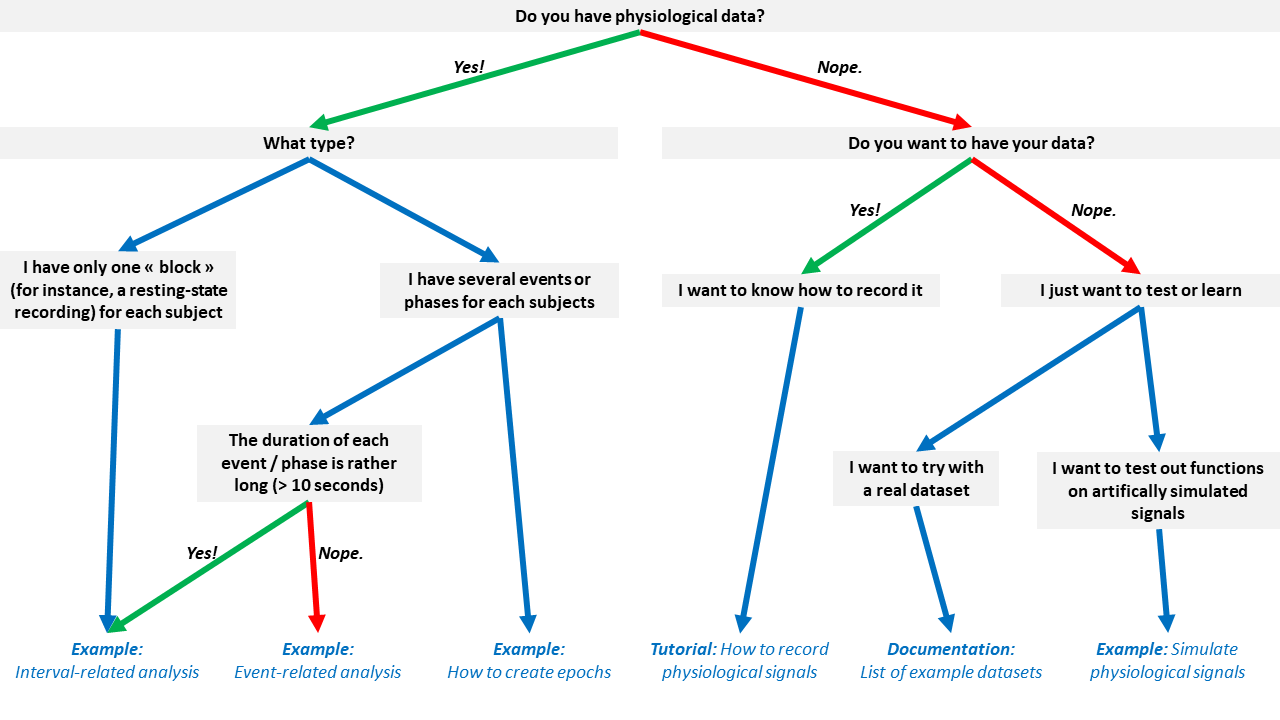
**Don't know which tutorial is suited for your case?** Follow this flowchart:


.. image:: https://raw.github.com/neuropsychology/NeuroKit/master/docs/readme/workflow.png
        :target: https://neuropsychology.github.io/NeuroKit/

Citation
---------

.. image:: https://zenodo.org/badge/218212111.svg
   :target: https://zenodo.org/badge/latestdoi/218212111

.. image:: https://img.shields.io/badge/details-authors-purple.svg?colorB=9C27B0
   :target: https://neuropsychology.github.io/NeuroKit/authors.html


The **NeuroKit2** paper can be found `here <https://doi.org/10.3758/s13428-020-01516-y>`_ 🎉 Additionally, you can get the reference directly from Python by running:

.. code-block:: python

    nk.cite()


.. code-block:: tex

    You can cite NeuroKit2 as follows:

    - Makowski, D., Pham, T., Lau, Z. J., Brammer, J. C., Lespinasse, F., Pham, H.,
    Schölzel, C., & Chen, S. A. (2021). NeuroKit2: A Python toolbox for neurophysiological signal processing.
    Behavior Research Methods, 53(4), 1689–1696. https://doi.org/10.3758/s13428-020-01516-y

    Full bibtex reference:

    @article{Makowski2021neurokit,
        author = {Dominique Makowski and Tam Pham and Zen J. Lau and Jan C. Brammer and Fran{\c{c}}ois Lespinasse and Hung Pham and Christopher Schölzel and S. H. Annabel Chen},
        title = {{NeuroKit}2: A Python toolbox for neurophysiological signal processing},
        journal = {Behavior Research Methods},
        volume = {53},
        number = {4},
        pages = {1689--1696},
        publisher = {Springer Science and Business Media {LLC}},
        doi = {10.3758/s13428-020-01516-y},
        url = {https://doi.org/10.3758%2Fs13428-020-01516-y},
        year = 2021,
        month = {feb}
    }


**Let us know if you used NeuroKit2 in a publication!** Open a new `discussion <https://github.com/neuropsychology/NeuroKit/discussions>`_ (select the *NK in publications* category) and link the paper. The community would be happy to know about how you used it and learn about your research. We could also feature it once we have a section on the website for papers that used the software.

..
    Design
    --------

    *NeuroKit2* is designed to provide a **consistent**, **accessible** yet **powerful** and **flexible** API.

    - **Consistency**: For each type of signals (ECG, RSP, EDA, EMG...), the same function names are called (in the form :code:`signaltype_functiongoal()`) to achieve equivalent goals, such as :code:`*_clean()`, :code:`*_findpeaks()`, :code:`*_process()`, :code:`*_plot()` (replace the star with the signal type, e.g., :code:`ecg_clean()`).
    - **Accessibility**: Using NeuroKit2 is made very easy for beginners through the existence of powerful high-level "master" functions, such as :code:`*_process()`, that performs cleaning, preprocessing and processing with sensible defaults.
    - **Flexibility**: However, advanced users can very easily build their own custom analysis pipeline by using the mid-level functions (such as :code:`*_clean()`, :code:`*_rate()`), offering more control and flexibility over their parameters.


Physiological Data Preprocessing
---------------------------------

Simulate physiological signals
^^^^^^^^^^^^^^^^^^^^^^^^^^^^^^^

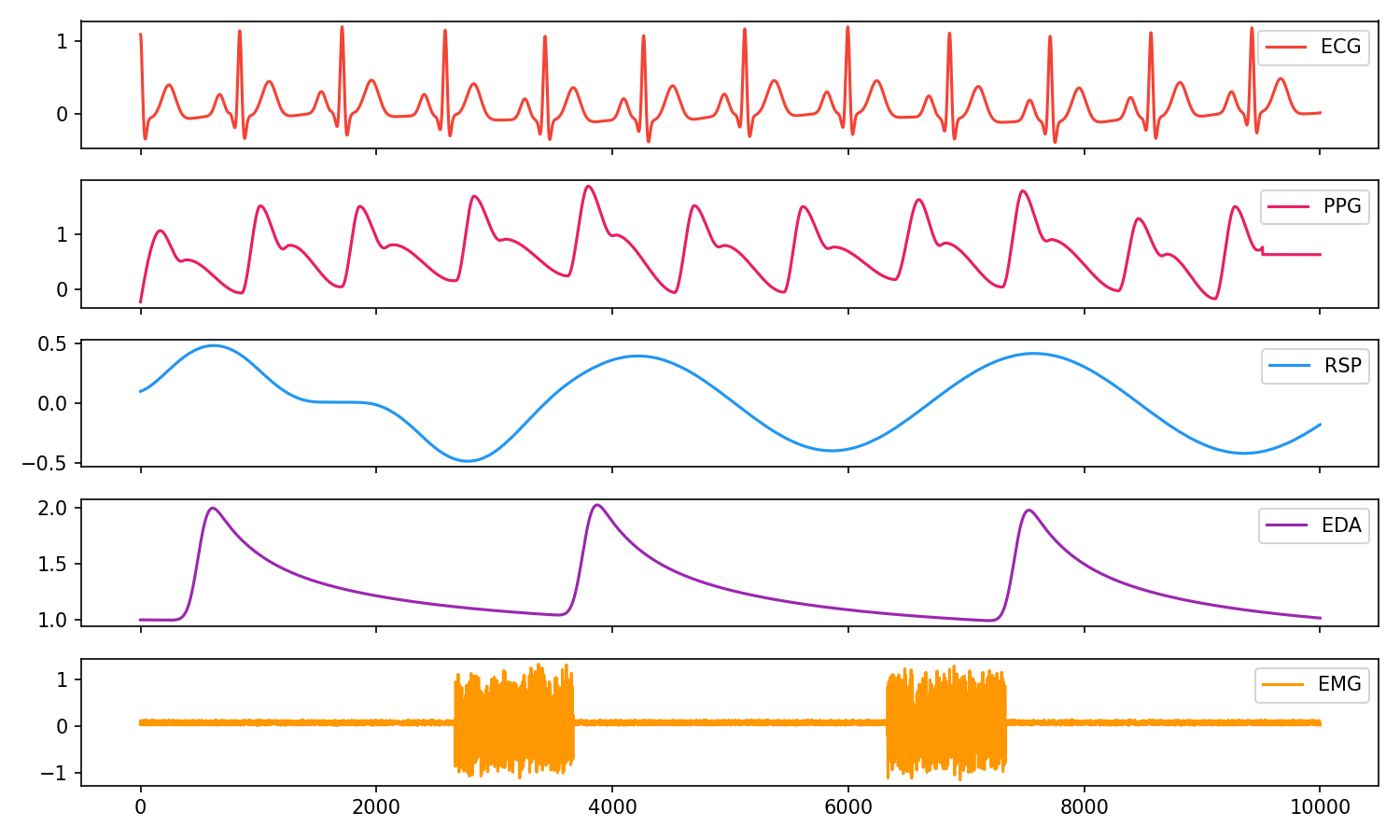
You can easily simulate artificial ECG (also `12-Lead multichannel ECGs <https://neuropsychology.github.io/NeuroKit/examples/ecg_generate_12leads/ecg_generate_12leads.html>`_), PPG, RSP, EDA, and EMG signals to test your scripts and algorithms.

.. code-block:: python

    import numpy as np
    import pandas as pd
    import neurokit2 as nk

    # Generate synthetic signals
    ecg = nk.ecg_simulate(duration=10, heart_rate=70)
    ppg = nk.ppg_simulate(duration=10, heart_rate=70)
    rsp = nk.rsp_simulate(duration=10, respiratory_rate=15)
    eda = nk.eda_simulate(duration=10, scr_number=3)
    emg = nk.emg_simulate(duration=10, burst_number=2)

    # Visualise biosignals
    data = pd.DataFrame({"ECG": ecg,
                         "PPG": ppg,
                         "RSP": rsp,
                         "EDA": eda,
                         "EMG": emg})
    nk.signal_plot(data, subplots=True)


.. image:: https://raw.github.com/neuropsychology/NeuroKit/master/docs/readme/README_simulation.png
        :target: https://neuropsychology.github.io/NeuroKit/examples/signal_simulation/signal_simulation.html


Electrodermal Activity (EDA/GSR)
^^^^^^^^^^^^^^^^^^^^^^^^^^^^^^^^^

.. code-block:: python

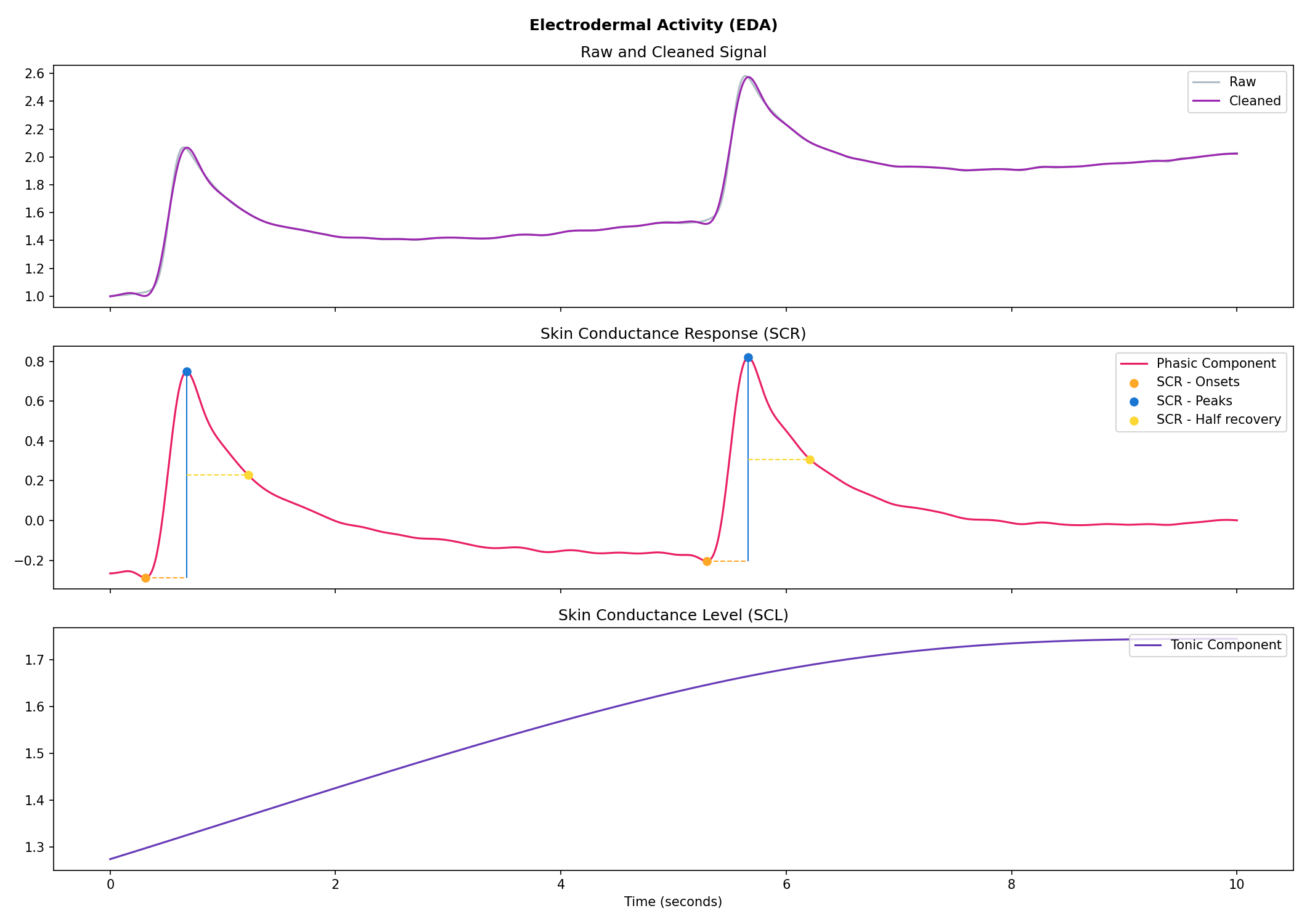
    # Generate 10 seconds of EDA signal (recorded at 250 samples / second) with 2 SCR peaks
    eda = nk.eda_simulate(duration=10, sampling_rate=250, scr_number=2, drift=0.01)

    # Process it
    signals, info = nk.eda_process(eda, sampling_rate=250)

    # Visualise the processing
    nk.eda_plot(signals, info)

.. image:: https://raw.github.com/neuropsychology/NeuroKit/master/docs/readme/README_eda.png
        :target: https://neuropsychology.github.io/NeuroKit/examples/eda_peaks/eda_peaks.html


Cardiac activity (ECG)
^^^^^^^^^^^^^^^^^^^^^^^^^^^^^^^

.. code-block:: python

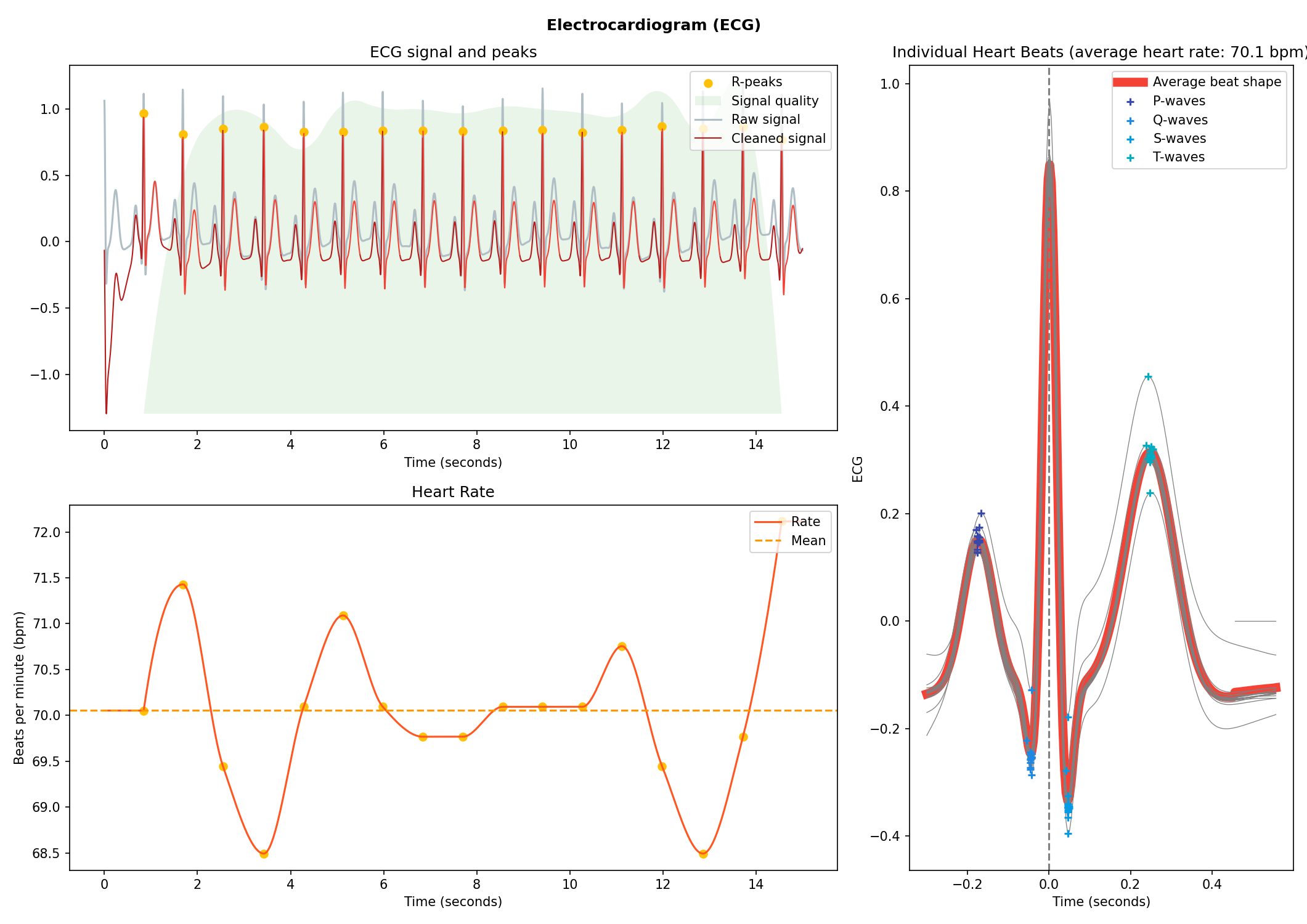
    # Generate 15 seconds of ECG signal (recorded at 250 samples/second)
    ecg = nk.ecg_simulate(duration=15, sampling_rate=250, heart_rate=70)

    # Process it
    signals, info = nk.ecg_process(ecg, sampling_rate=250)

    # Visualise the processing
    nk.ecg_plot(signals, info)


.. image:: https://raw.github.com/neuropsychology/NeuroKit/master/docs/readme/README_ecg.png
        :target: https://neuropsychology.github.io/NeuroKit/examples/ecg_heartbeats/ecg_heartbeats.html


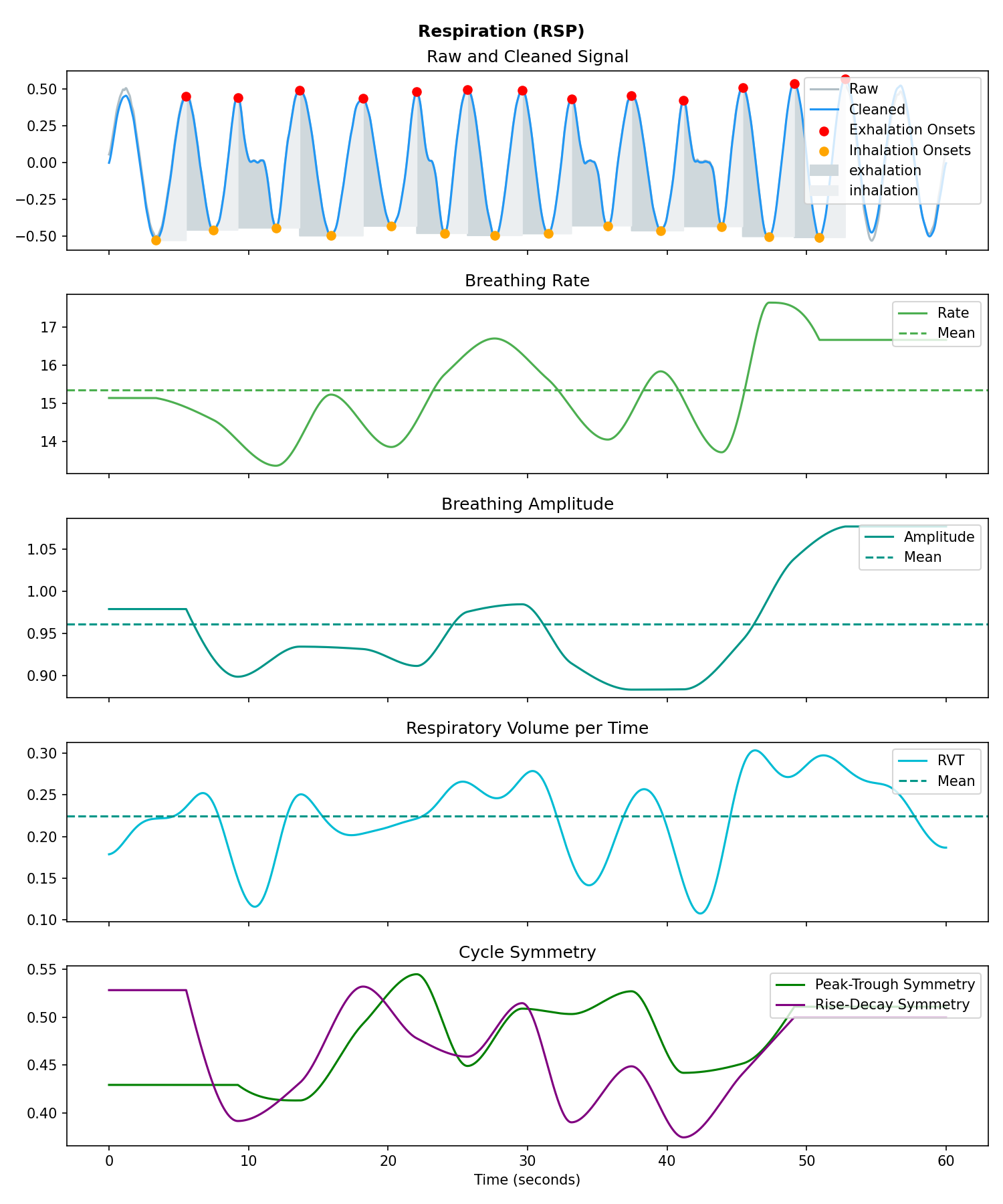
Respiration (RSP)
^^^^^^^^^^^^^^^^^^^

.. code-block:: python

    # Generate one minute of respiratory (RSP) signal (recorded at 250 samples / second)
    rsp = nk.rsp_simulate(duration=60, sampling_rate=250, respiratory_rate=15)

    # Process it
    signals, info = nk.rsp_process(rsp, sampling_rate=250)

    # Visualise the processing
    nk.rsp_plot(signals, info)


.. image:: https://raw.github.com/neuropsychology/NeuroKit/master/docs/readme/README_rsp.png
        :target: https://neuropsychology.github.io/NeuroKit/examples/rsp_rrv/rsp_rrv.html


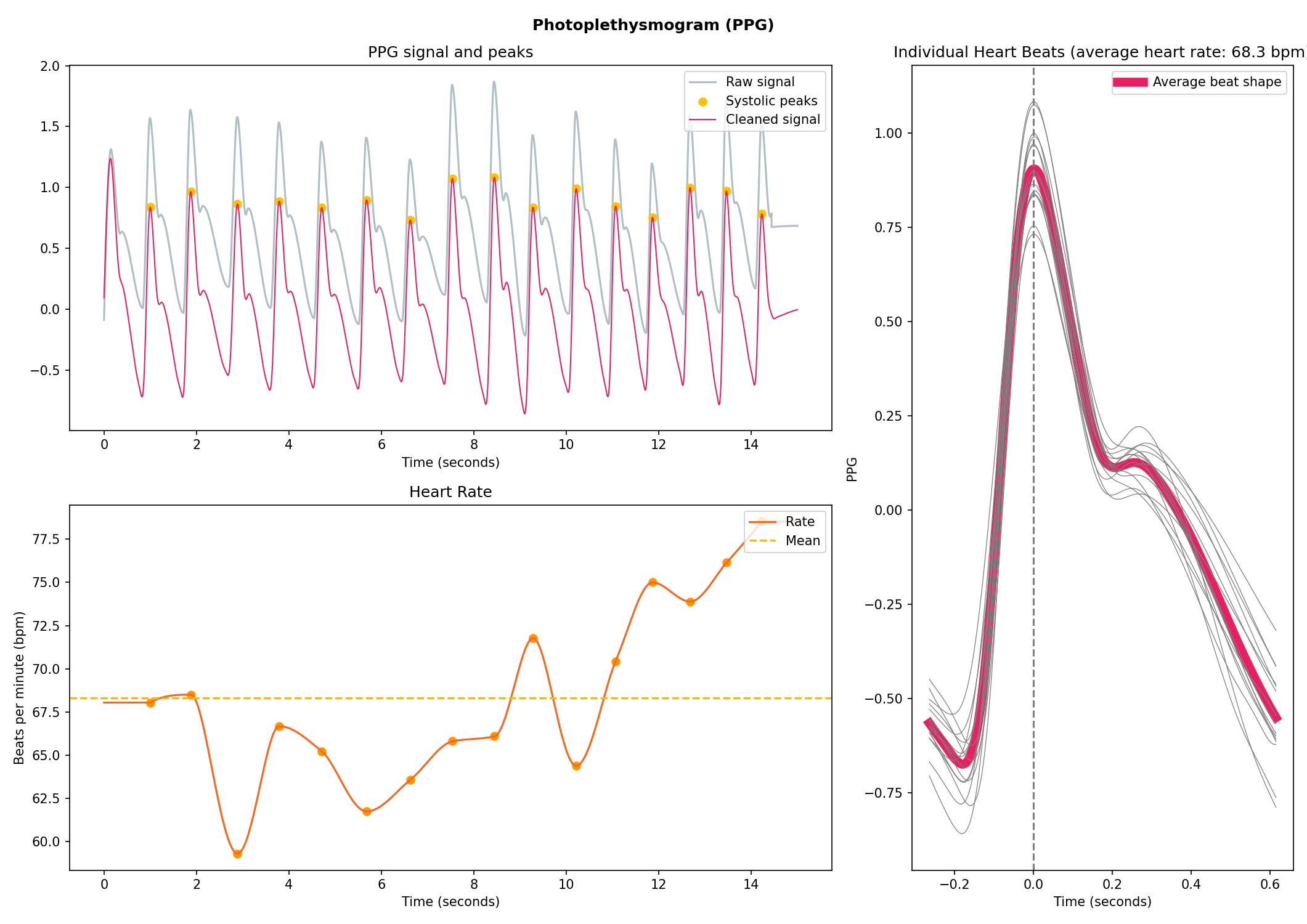
Photoplethysmography (PPG/BVP)
^^^^^^^^^^^^^^^^^^^^^^^^^^^^^^^

.. code-block:: python

    # Generate 15 seconds of PPG signal (recorded at 250 samples/second)
    ppg = nk.ppg_simulate(duration=15, sampling_rate=250, heart_rate=70)

    # Process it
    signals, info = nk.ppg_process(ppg, sampling_rate=250)

    # Visualize the processing
    nk.ppg_plot(signals, info)


.. image:: https://raw.github.com/neuropsychology/NeuroKit/master/docs/readme/README_ppg.png


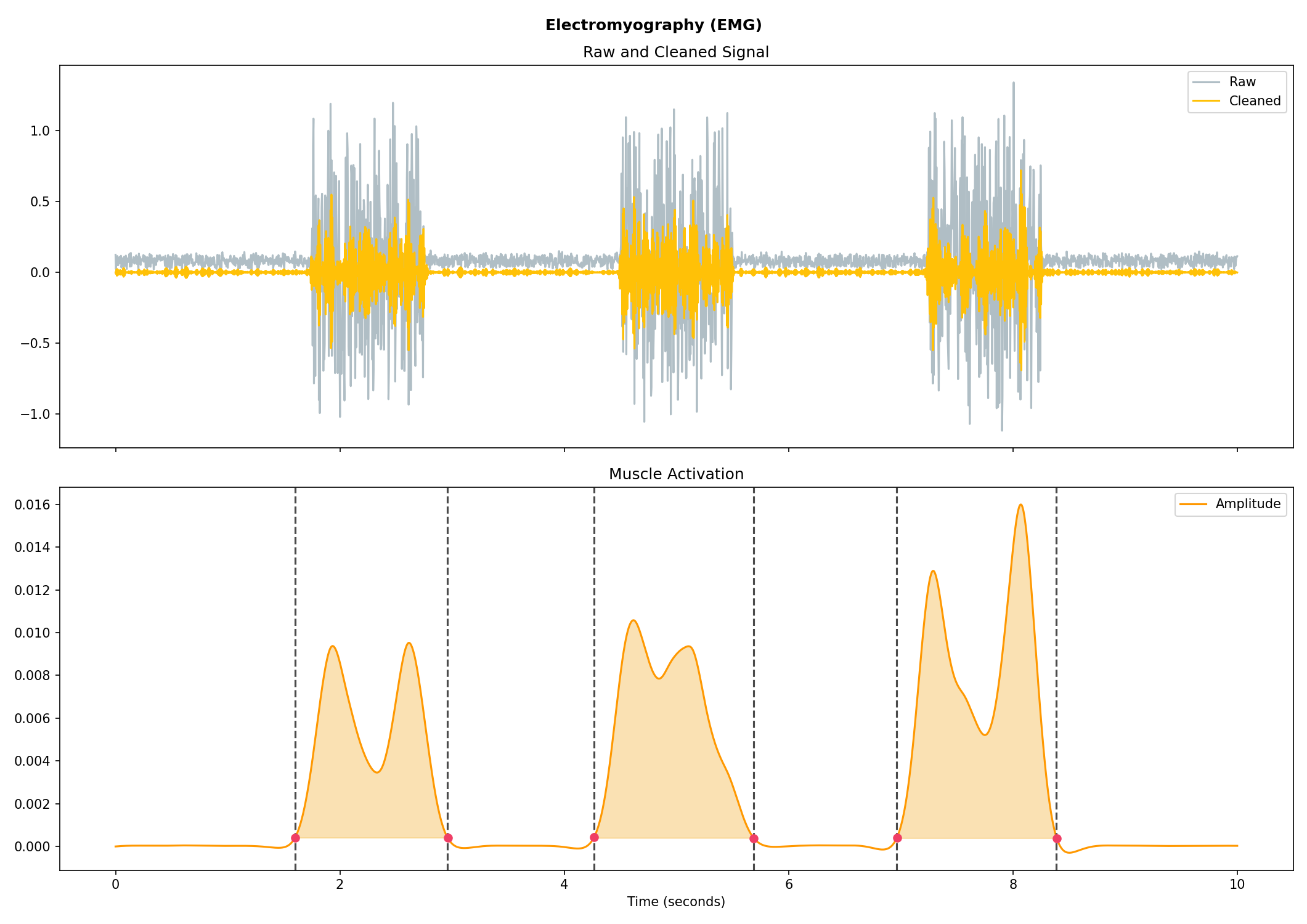
Electromyography (EMG)
^^^^^^^^^^^^^^^^^^^^^^^

.. code-block:: python

    # Generate 10 seconds of EMG signal (recorded at 250 samples/second)
    emg = nk.emg_simulate(duration=10, sampling_rate=250, burst_number=3)

    # Process it
    signals, info = nk.emg_process(emg, sampling_rate=250)

    # Visualise the processing
    nk.emg_plot(signals, info)


.. image:: https://raw.github.com/neuropsychology/NeuroKit/master/docs/readme/README_emg.png


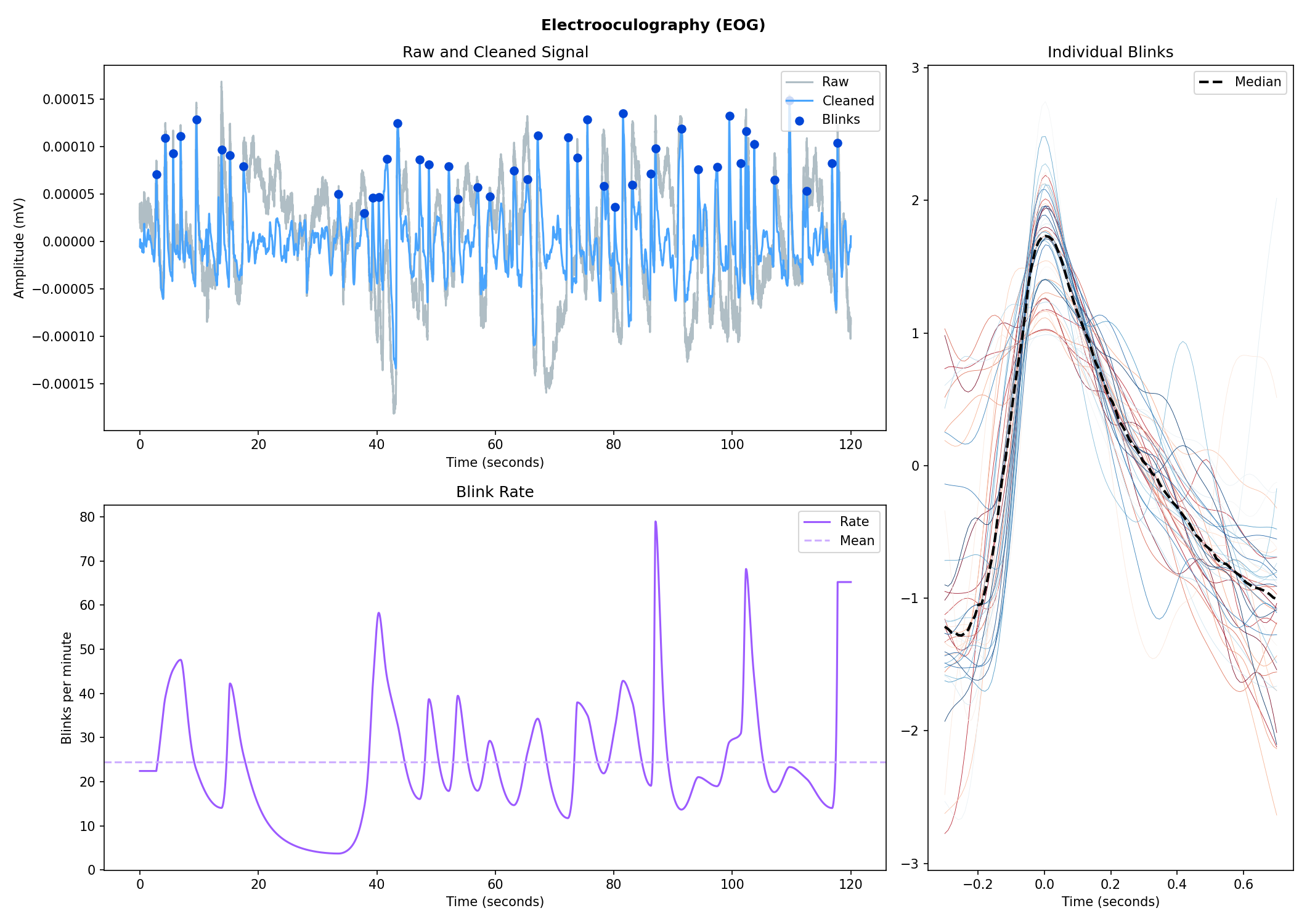
Electrooculography (EOG)
^^^^^^^^^^^^^^^^^^^^^^^^^^

.. code-block:: python

    # Import EOG data
    eog_signal = nk.data("eog_100hz")

    # Process it
    signals, info = nk.eog_process(eog_signal, sampling_rate=100)

    # Plot
    nk.eog_plot(signals, info)


.. image:: https://raw.github.com/neuropsychology/NeuroKit/master/docs/readme/README_eog.png


Electrogastrography (EGG)
^^^^^^^^^^^^^^^^^^^^^^^^^^^^^^^

Consider `helping us develop it <https://neuropsychology.github.io/NeuroKit/resources/contributing.html>`_!


Physiological Data Analysis
----------------------------

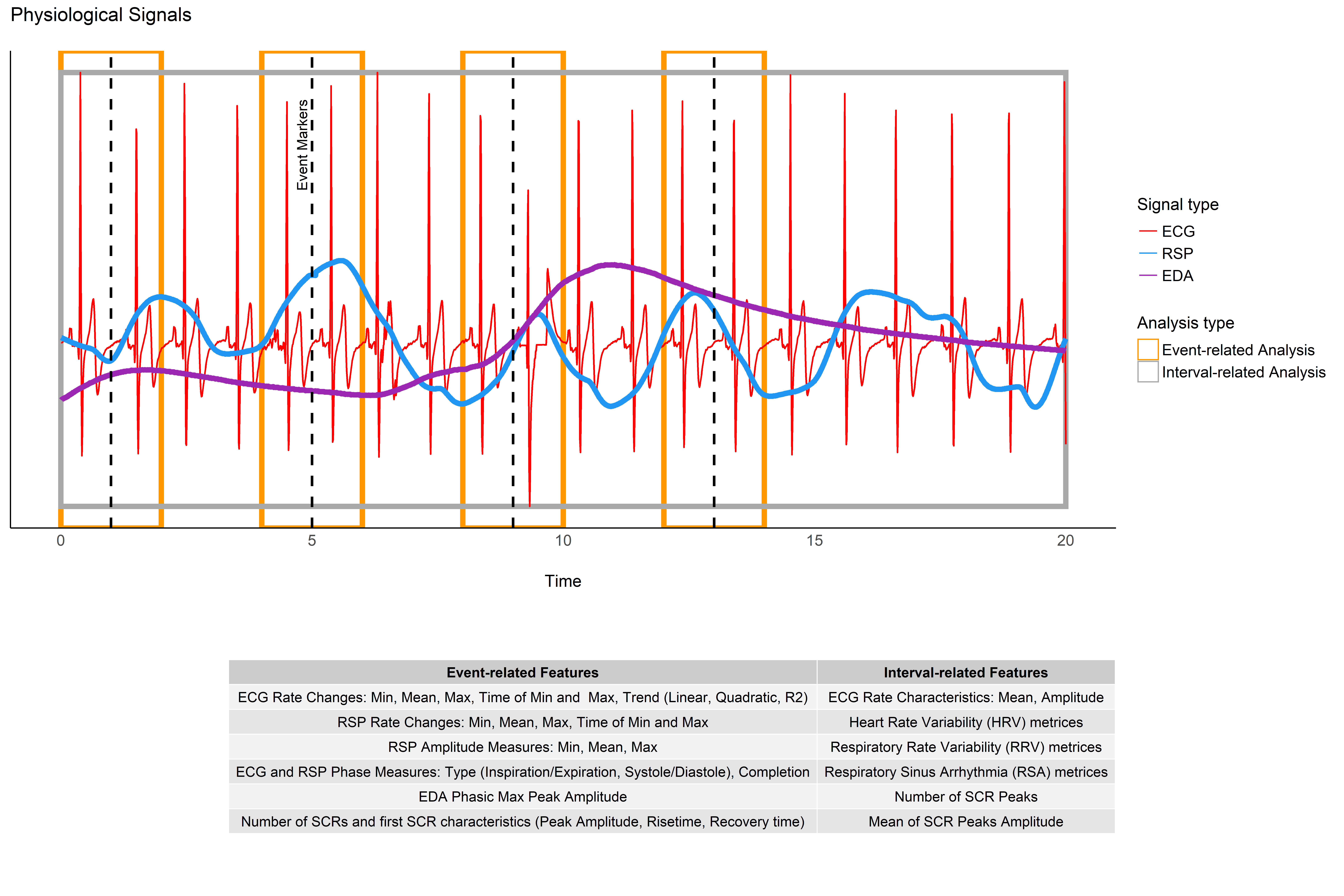
The analysis of physiological data usually comes in two types, **event-related** or **interval-related**.


.. image:: https://raw.github.com/neuropsychology/NeuroKit/master/docs/readme/features.png


Event-related
^^^^^^^^^^^^^^

This type of analysis refers to physiological changes immediately occurring in response to an event.
For instance, physiological changes following the presentation of a stimulus (e.g., an emotional stimulus) are indicated by
the dotted lines in the figure above. In this situation, the analysis is epoch-based.
An epoch is a short chunk of the physiological signal (usually < 10 seconds), that is locked to a specific stimulus and hence
the physiological signals of interest are time-segmented accordingly. This is represented by the orange boxes in the figure above.
In this case, using `bio_analyze()` will compute features like rate changes, peak characteristics, and phase characteristics.

- `Event-related example <https://neuropsychology.github.io/NeuroKit/examples/bio_eventrelated/bio_eventrelated.html>`_

Interval-related
^^^^^^^^^^^^^^^^^

This type of analysis refers to the physiological characteristics and features that occur over
longer periods of time (from a few seconds to days of activity). Typical use cases are either
periods of resting state, in which the activity is recorded for several minutes while the participant
is at rest, or during different conditions in which there is no specific time-locked event
(e.g., watching movies, listening to music, engaging in physical activity, etc.). For instance,
this type of analysis is used when people want to compare the physiological activity under different
intensities of physical exercise, different types of movies, or different intensities of
stress. To compare event-related and interval-related analysis, we can refer to the example figure above.
For example, a participant might be watching a 20s-long short film where particular stimuli of
interest in the movie appear at certain time points (marked by the dotted lines). While
event-related analysis pertains to the segments of signals within the orange boxes (to understand the physiological
changes pertaining to the appearance of stimuli), interval-related analysis can be
applied on the entire 20s duration to investigate how physiology fluctuates in general.
In this case, using `bio_analyze()` will compute features such as rate characteristics (in particular,
variability metrics) and peak characteristics.

- `Interval-related example <https://neuropsychology.github.io/NeuroKit/examples/bio_intervalrelated/bio_intervalrelated.html>`_


Heart Rate Variability (HRV)
----------------------------
.. image:: https://img.shields.io/badge/Tutorial-HRV-green
        :target: https://www.mdpi.com/1424-8220/21/12/3998

Check-out our **Heart Rate Variability in Psychology: A Review of HRV Indices and an Analysis Tutorial** `paper <https://doi.org/10.3390/s21123998>`_ for:

- a comprehensive review of the most up-to-date HRV indices
- a discussion of their significance in psychological research and practices
- a step-by-step guide for HRV analysis using **NeuroKit2**


.. code-block:: tex

    You can cite the paper as follows:

    - Pham, T., Lau, Z. J., Chen, S. H. A., & Makowski, D. (2021).
    Heart Rate Variability in Psychology: A Review of HRV Indices and an Analysis Tutorial.
    Sensors, 21(12), 3998. https://doi:10.3390/s21123998


- **Compute HRV indices using Python**

  - **Time domain**: RMSSD, MeanNN, SDNN, SDSD, CVNN, etc.
  - **Frequency domain**: Spectral power density in various frequency bands (Ultra low/ULF, Very low/VLF, Low/LF, High/HF, Very high/VHF), Ratio of LF to HF power, Normalized LF (LFn) and HF (HFn), Log transformed HF (LnHF).
  - **Nonlinear domain**: Spread of RR intervals (SD1, SD2, ratio between SD2 to SD1), Cardiac Sympathetic Index (CSI), Cardial Vagal Index (CVI), Modified CSI, Sample Entropy (SampEn).


.. code-block:: python

    # Download data
    data = nk.data("bio_resting_8min_100hz")

    # Find peaks
    peaks, info = nk.ecg_peaks(data["ECG"], sampling_rate=100)

    # Compute HRV indices
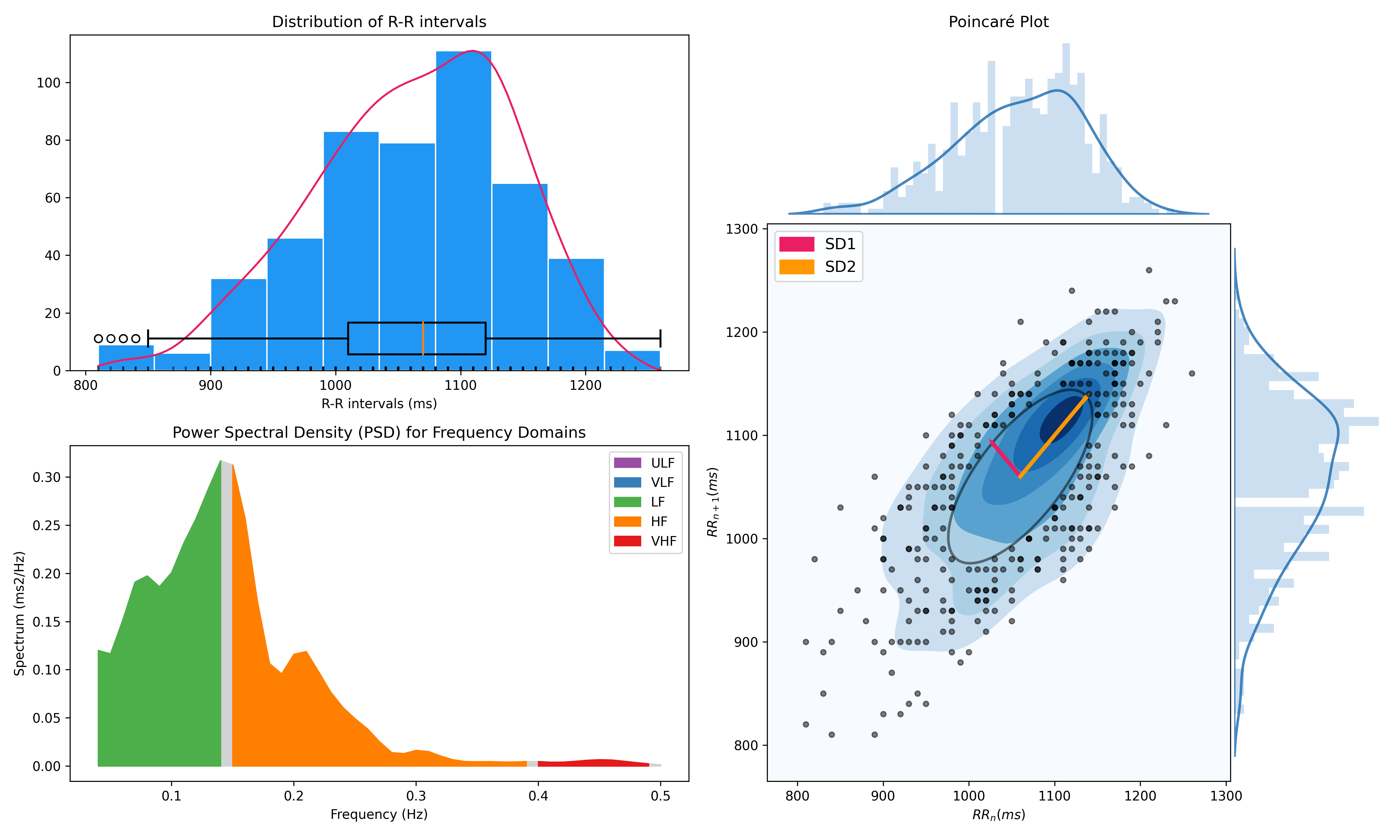
    nk.hrv(peaks, sampling_rate=100, show=True)
    >>>    HRV_RMSSD  HRV_MeanNN   HRV_SDNN  ...   HRV_CVI  HRV_CSI_Modified  HRV_SampEn
    >>> 0  69.697983  696.395349  62.135891  ...  4.829101        592.095372    1.259931


.. image:: https://raw.github.com/neuropsychology/NeuroKit/master/docs/readme/README_hrv.png

Miscellaneous
----------------------------

ECG Delineation
^^^^^^^^^^^^^^^^^^^^^^^^^^^^^^^^^^^^^^^^^^^^^^^

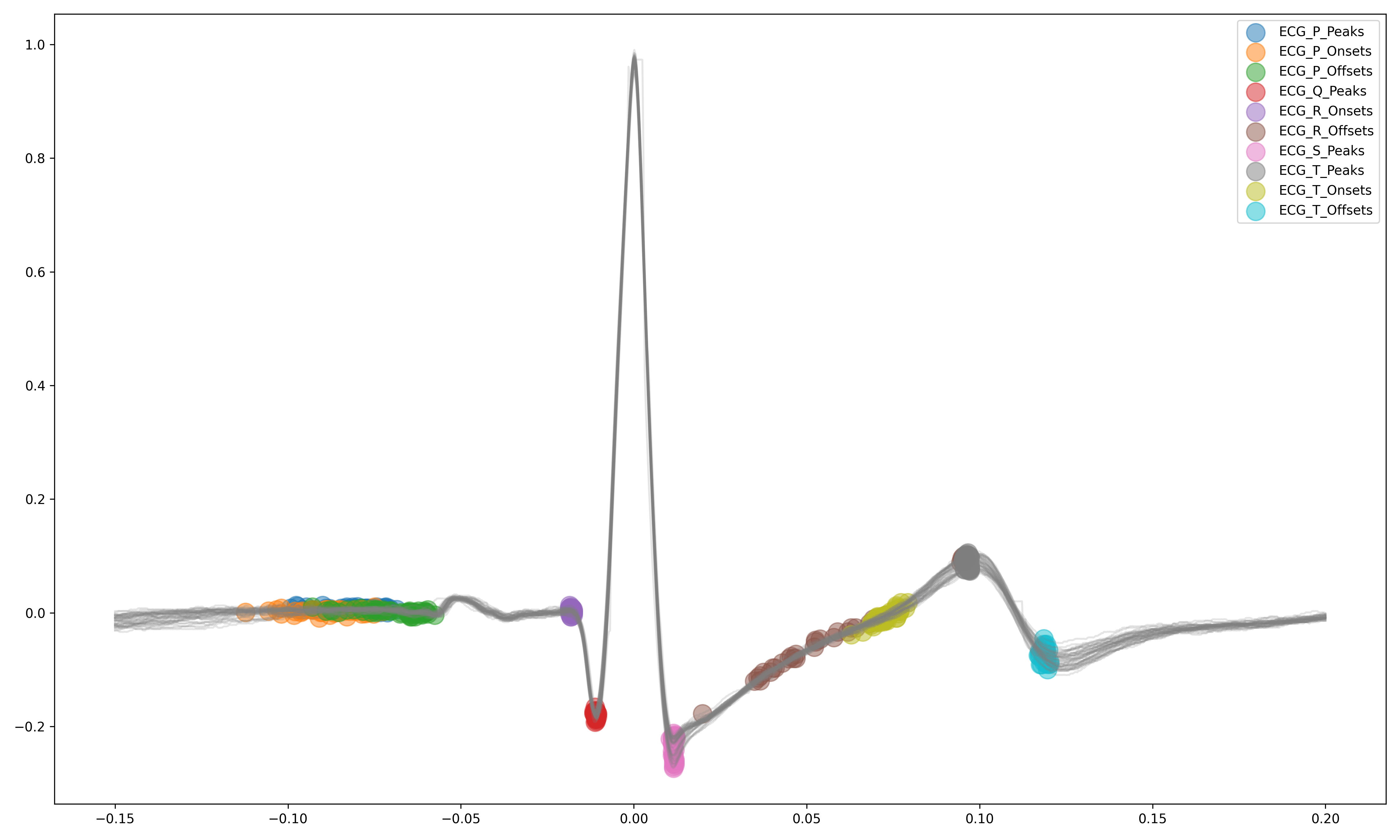
- Delineate the QRS complex of an electrocardiac signal (ECG) including P-peaks, T-peaks, as well as their onsets and offsets.


.. code-block:: python


    # Download data
    ecg_signal = nk.data(dataset="ecg_3000hz")

    # Extract R-peaks locations
    _, rpeaks = nk.ecg_peaks(ecg_signal, sampling_rate=3000)

    # Delineate
    signal, waves = nk.ecg_delineate(ecg_signal, rpeaks, sampling_rate=3000, method="dwt", show=True, show_type='all')


.. image:: https://raw.github.com/neuropsychology/NeuroKit/master/docs/readme/README_delineate.png
       :target: https://neuropsychology.github.io/NeuroKit/examples/ecg_delineate/ecg_delineate.html


Signal Processing
^^^^^^^^^^^^^^^^^^^^^^^^^^^^^^^^^^^^^^^^^^^^^^^

- **Signal processing functionalities**

  - **Filtering**: Using different methods.
  - **Detrending**: Remove the baseline drift or trend.
  - **Distorting**: Add noise and artifacts.

.. code-block:: python

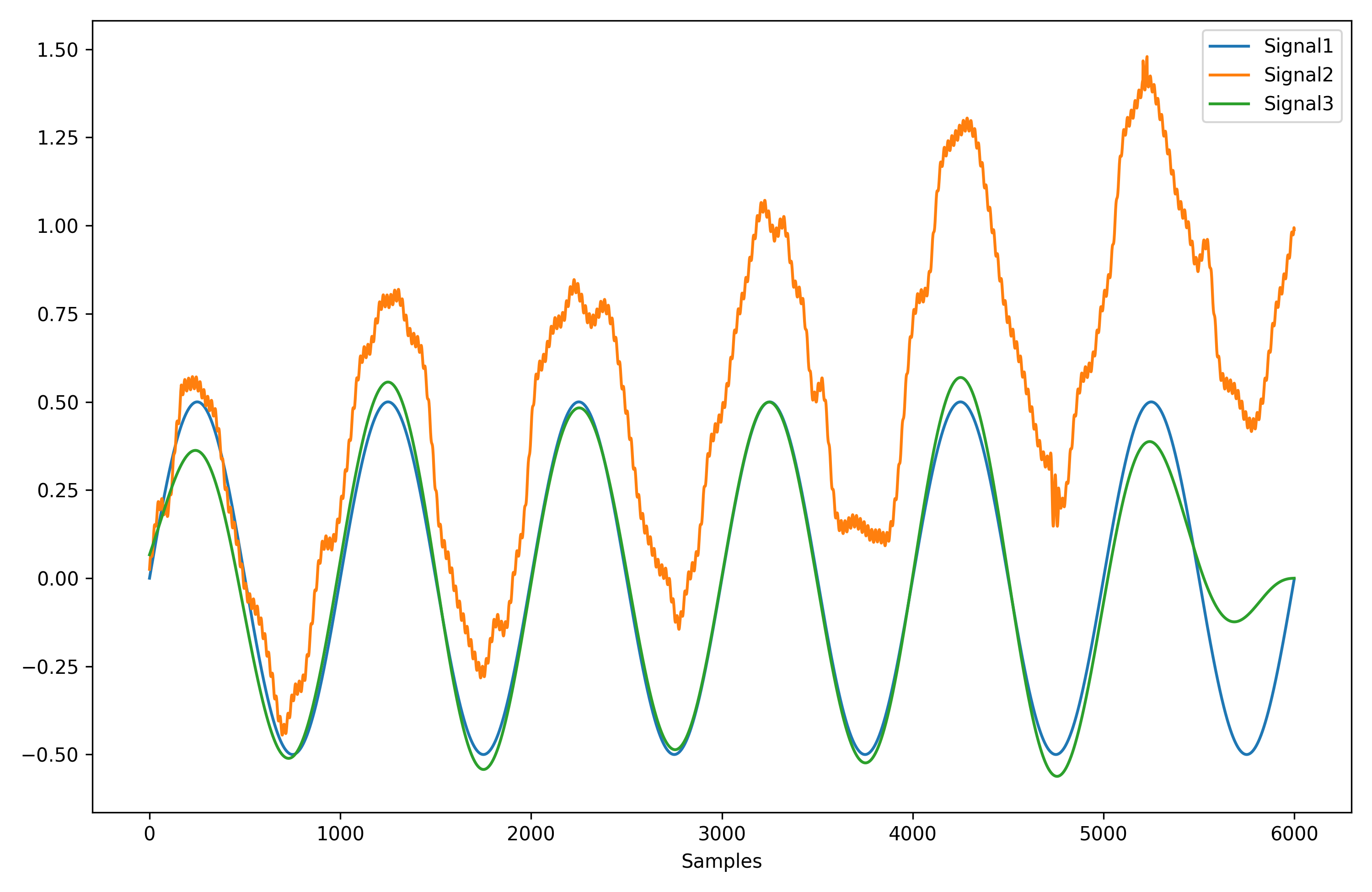
    # Generate original signal
    original = nk.signal_simulate(duration=6, frequency=1)

    # Distort the signal (add noise, linear trend, artifacts, etc.)
    distorted = nk.signal_distort(original,
                                  noise_amplitude=0.1,
                                  noise_frequency=[5, 10, 20],
                                  powerline_amplitude=0.05,
                                  artifacts_amplitude=0.3,
                                  artifacts_number=3,
                                  linear_drift=0.5)

    # Clean (filter and detrend)
    cleaned = nk.signal_detrend(distorted)
    cleaned = nk.signal_filter(cleaned, lowcut=0.5, highcut=1.5)

    # Compare the 3 signals
    plot = nk.signal_plot([original, distorted, cleaned])


.. image:: https://raw.github.com/neuropsychology/NeuroKit/master/docs/readme/README_signalprocessing.png


Complexity (Entropy, Fractal Dimensions, ...)
^^^^^^^^^^^^^^^^^^^^^^^^^^^^^^^^^^^^^^^^^^^^^^^

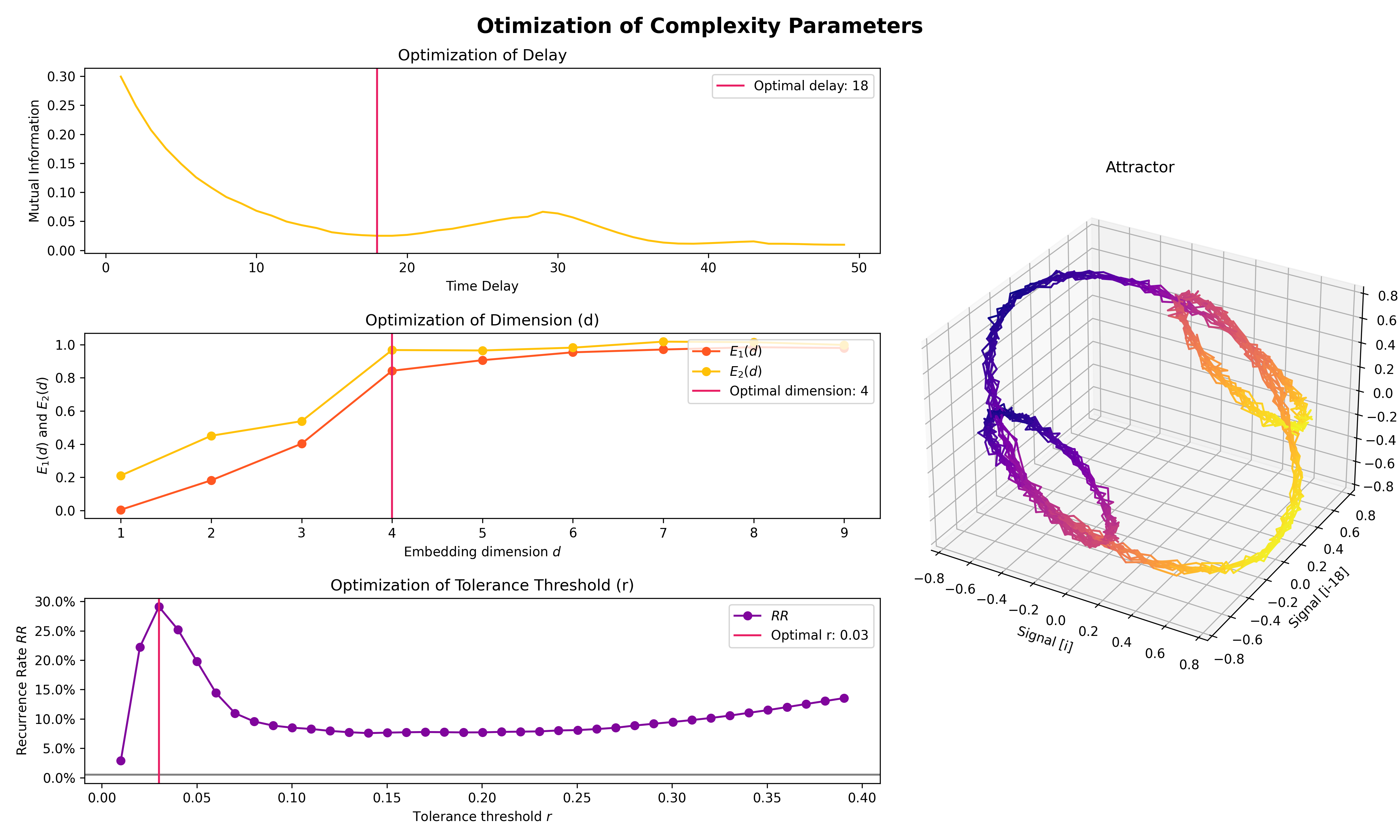
- **Optimize complexity parameters** (delay *tau*, dimension *m*, tolerance *r*)

.. code-block:: python

    # Generate signal
    signal = nk.signal_simulate(frequency=[1, 3], noise=0.01, sampling_rate=200)

    # Find optimal time delay, embedding dimension, and r
    parameters = nk.complexity_optimize(signal, show=True)


.. image:: https://raw.github.com/neuropsychology/NeuroKit/master/docs/readme/README_complexity_optimize.png
        :target: https://neuropsychology.github.io/NeuroKit/functions/complexity.html


- **Compute complexity features**

  - **Entropy**: Sample Entropy (SampEn), Approximate Entropy (ApEn), Fuzzy Entropy (FuzzEn), Multiscale Entropy (MSE), Shannon Entropy (ShEn)
  - **Fractal dimensions**: Correlation Dimension D2, ...
  - **Detrended Fluctuation Analysis**

.. code-block:: python

    nk.entropy_sample(signal)
    nk.entropy_approximate(signal)


Signal Decomposition
^^^^^^^^^^^^^^^^^^^^^^^^^^^^^^^^^^^^^^^^^^^^^^^

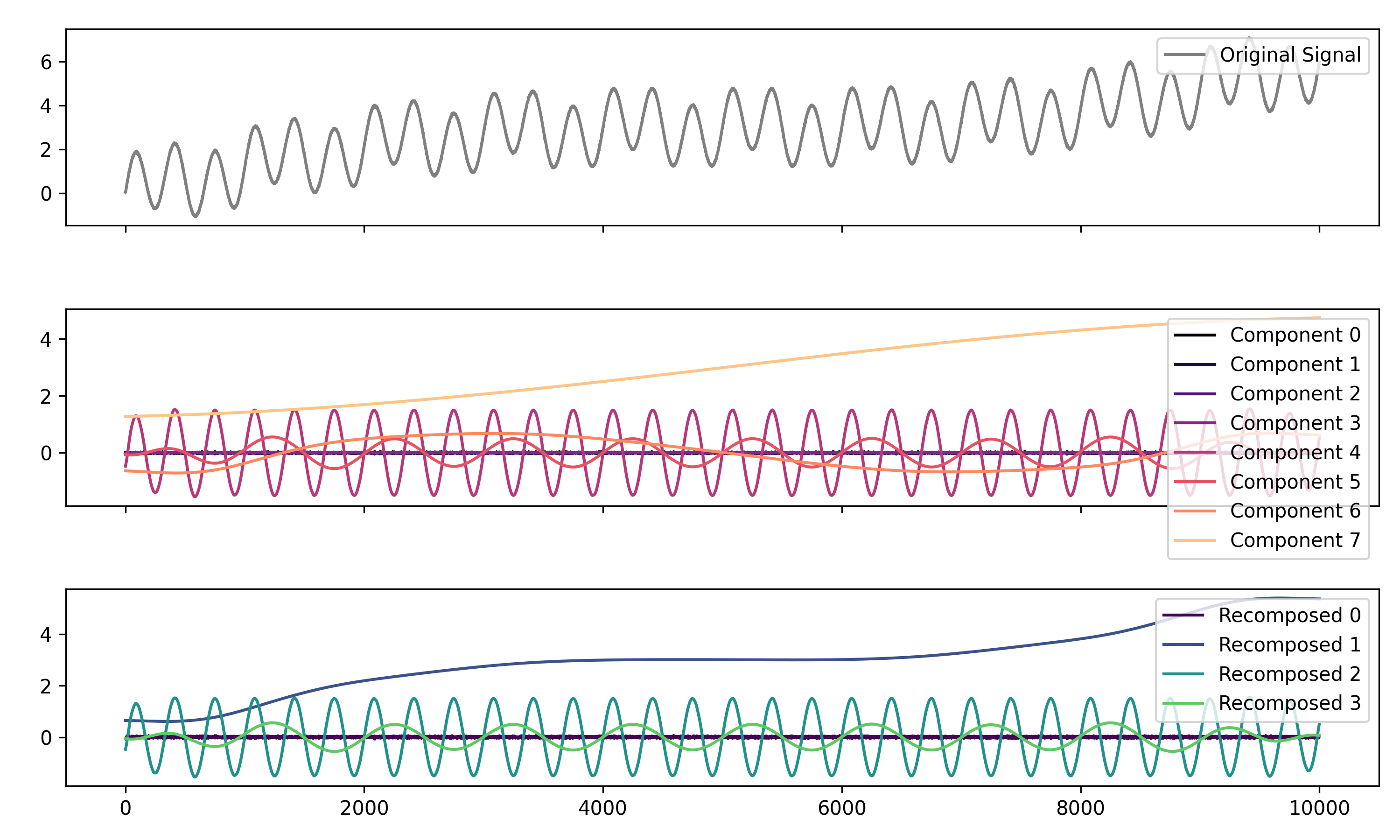
.. code-block:: python

    # Create complex signal
    signal = nk.signal_simulate(duration=10, frequency=1)  # High freq
    signal += 3 * nk.signal_simulate(duration=10, frequency=3)  # Higher freq
    signal += 3 * np.linspace(0, 2, len(signal))  # Add baseline and linear trend
    signal += 2 * nk.signal_simulate(duration=10, frequency=0.1, noise=0)  # Non-linear trend
    signal += np.random.normal(0, 0.02, len(signal))  # Add noise

    # Decompose signal using Empirical Mode Decomposition (EMD)
    components = nk.signal_decompose(signal, method='emd')
    nk.signal_plot(components)  # Visualize components

    # Recompose merging correlated components
    recomposed = nk.signal_recompose(components, threshold=0.99)
    nk.signal_plot(recomposed)  # Visualize components

.. image:: https://raw.github.com/neuropsychology/NeuroKit/master/docs/readme/README_decomposition.png
        :target: https://neuropsychology.github.io/NeuroKit/functions/signal.html#signal-decompose

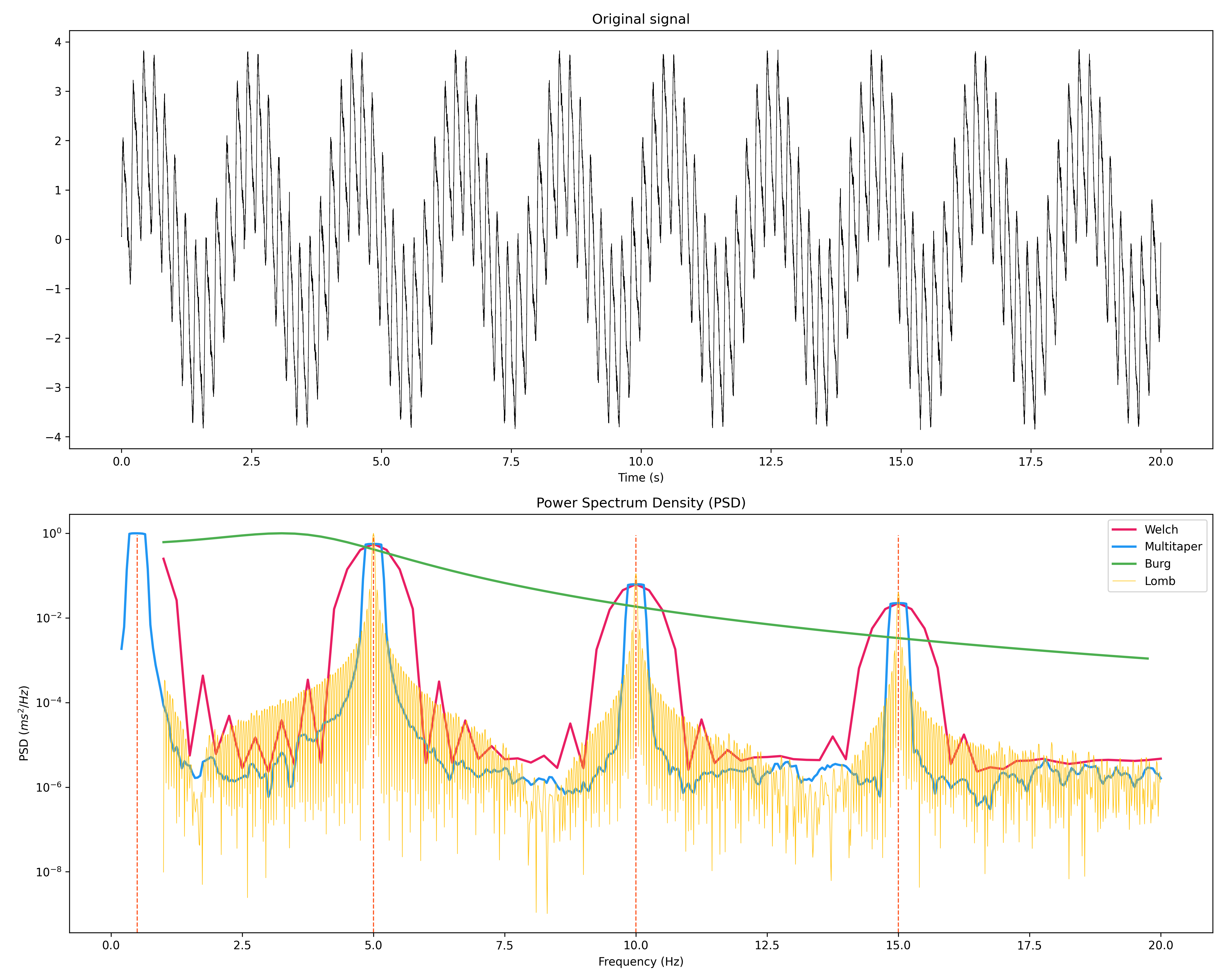
Signal Power Spectrum Density (PSD)
^^^^^^^^^^^^^^^^^^^^^^^^^^^^^^^^^^^^^^^^^^^^^^^
.. code-block:: python

    # Generate complex signal
    signal = nk.signal_simulate(duration=20, frequency=[0.5, 5, 10, 15], amplitude=[2, 1.5, 0.5, 0.3], noise=0.025)

    # Get the PSD using different methods
    welch = nk.signal_psd(signal, method="welch", min_frequency=1, max_frequency=20, show=True)
    multitaper = nk.signal_psd(signal, method="multitapers", max_frequency=20, show=True)
    lomb = nk.signal_psd(signal, method="lomb", min_frequency=1, max_frequency=20, show=True)
    burg = nk.signal_psd(signal, method="burg", min_frequency=1, max_frequency=20, order=10, show=True)

.. image:: https://raw.github.com/neuropsychology/NeuroKit/master/docs/readme/README_psd.png
        :target: https://neuropsychology.github.io/NeuroKit/functions/signal.html#signal-psd

Statistics
^^^^^^^^^^^^^^^^^^^^^^^^^^^^^^^^^^^^^^^^^^^^^^^

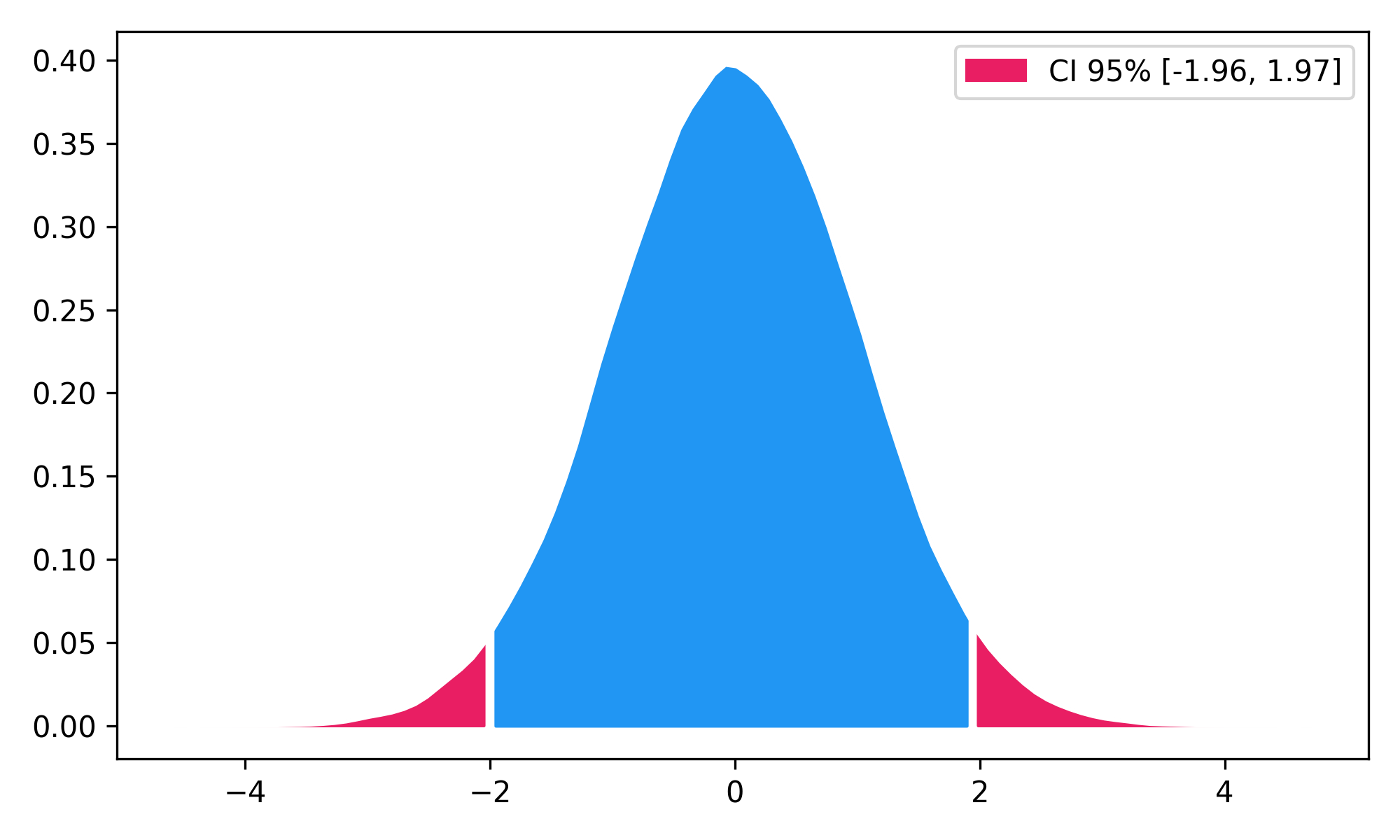
- **Highest Density Interval (HDI)**

.. code-block:: python

    x = np.random.normal(loc=0, scale=1, size=100000)

    ci_min, ci_max = nk.hdi(x, ci=0.95, show=True)

.. image:: https://raw.github.com/neuropsychology/NeuroKit/master/docs/readme/README_hdi.png
        :target: https://neuropsychology.github.io/NeuroKit/functions/stats.html#hdi

.. used_at_section

Popularity
---------------------

.. image:: https://img.shields.io/pypi/dd/neurokit2
        :target: https://pypi.python.org/pypi/neurokit2

.. image:: https://img.shields.io/github/stars/neuropsychology/NeuroKit
        :target: https://github.com/neuropsychology/NeuroKit/stargazers

.. image:: https://img.shields.io/github/forks/neuropsychology/NeuroKit
        :target: https://github.com/neuropsychology/NeuroKit/network


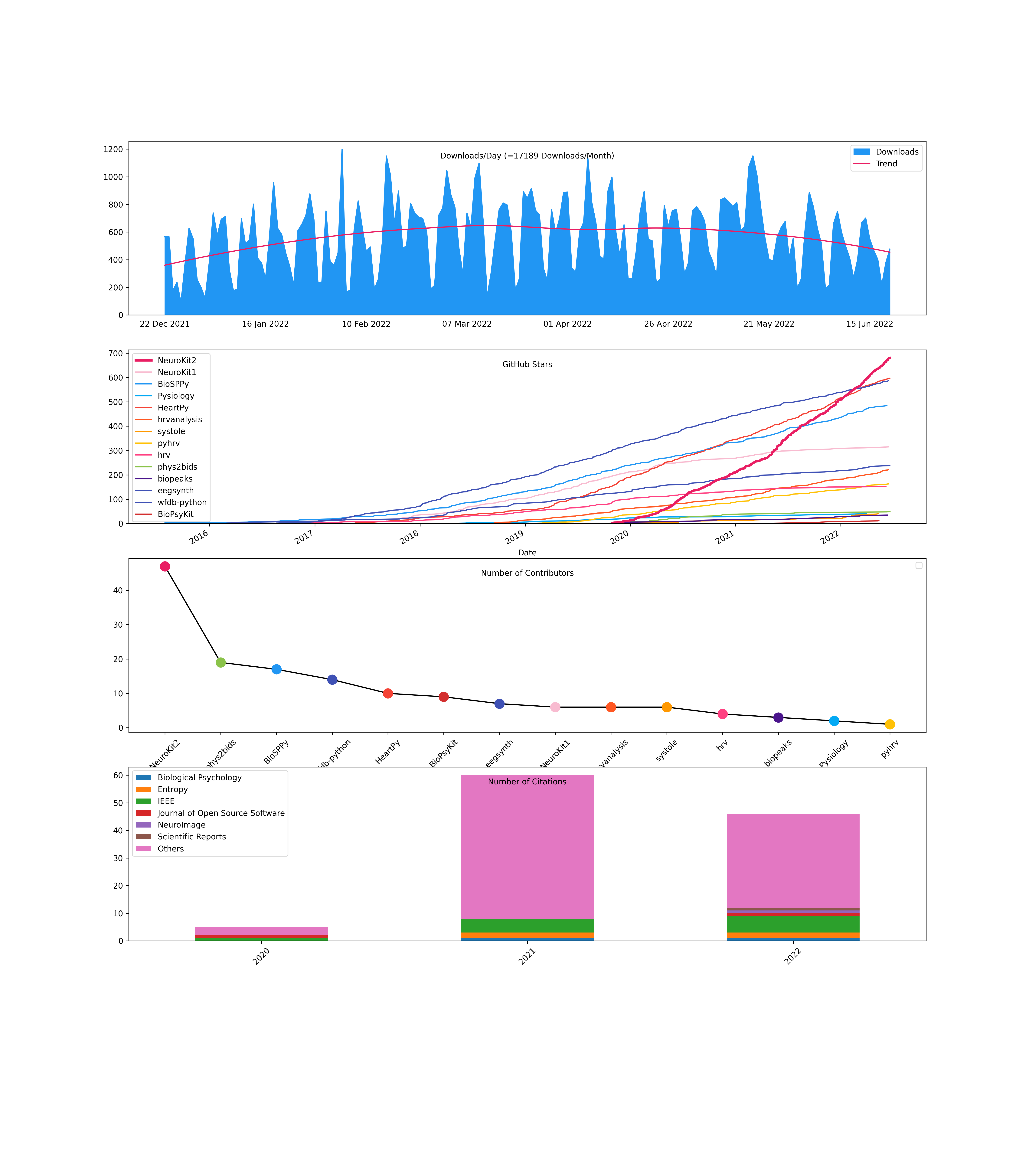
NeuroKit2 is one of the most welcoming packages for new contributors and users, as well as the fastest-growing package. So stop hesitating and hop on board 🤗

.. image:: https://raw.github.com/neuropsychology/NeuroKit/dev/docs/readme/README_popularity.png
        :target: https://pypi.python.org/pypi/neurokit2


Used at
-------

|ntu| |univ_paris| |univ_duke| |uni_auckland| |uni_pittsburh| |uni_washington|

.. |ntu| image:: https://upload.wikimedia.org/wikipedia/en/thumb/c/c6/Nanyang_Technological_University.svg/1024px-Nanyang_Technological_University.svg.png
   :height: 70
.. |univ_duke| image:: https://www.tutelaprep.com/blog/wp-content/uploads/2019/12/duke.png
   :height: 70
.. |univ_paris| image:: https://study-eu.s3.amazonaws.com/uploads/university/universit--de-paris-logo.svg
   :height: 70
.. |uni_auckland| image:: https://upload.wikimedia.org/wikipedia/en/thumb/a/ae/University_of_Auckland.svg/1024px-University_of_Auckland.svg.png
   :height: 70
.. |uni_pittsburh| image:: https://upload.wikimedia.org/wikipedia/en/thumb/f/fb/University_of_Pittsburgh_seal.svg/1200px-University_of_Pittsburgh_seal.svg.png
   :height: 70
.. |uni_washington| image:: https://upload.wikimedia.org/wikipedia/en/thumb/5/58/University_of_Washington_seal.svg/768px-University_of_Washington_seal.svg.png
   :height: 70


Disclaimer
----------
*The authors do not provide any warranty. If this software causes your keyboard to blow up, your brain to liquefy, your toilet to clog or a zombie plague to break loose, the authors CANNOT IN ANY WAY be held responsible.*

Contributors & Acknowledgments
==============================

NeuroKit2 is developed and maintained by the neuropsychology research community. The full list of contributors is available on GitHub <https://github.com/neuropsychology/NeuroKit/graphs/contributors>_.
h
**Contributing**: If you want to contribute to NeuroKit2, please visit the GitHub repository