ewccli is the European Weather Cloud (EWC) Command Line Interface (CLI). This tool is developed to support EWC users on the use of the EWC services.
For more info about this SW, you may contact the European Weather Cloud <support@europeanweather.cloud>.
Copyright © EUMETSAT, ECMWF 2025.
The provided code and instructions are licensed under GPLv3+. They are intended to automate the setup of an environment that includes third-party software components. The usage and distribution terms of the resulting environment are subject to the individual licenses of those third-party libraries.
Users are responsible for reviewing and complying with the licenses of all third-party components included in the environment.
Contact EUMETSAT for details on the usage and distribution terms.
- Francesco Murdaca - Initial work - EUMETSAT
- You will need a python environment to run the library implementation of this code. Python version 3.11 or higher.
- git installed on your operating system. (usually is available to most OS nowadays)
You can use the following link to obtain:
- Applications Credentials (ID and secret)
We recommend installing ewccli inside a virtual environment to avoid dependency conflicts with system packages.
The EWC CLI Python package is available through PyPI:
pip install ewccli- Fork this repository and move into it
git clone THIS_REPO && cd ewccli- Create virtualenv with minimum python version > 3.10
python3 -m venv ewcclienv- Activate the virtual environment
source ./ewcclienv/bin/activate- Upgrade pip
pip install --upgrade pip- Install the package
pip install -e .Then run ewc to verify everything works:

If you get a WARNING like WARNING: The script ewc is installed in '~/.local/bin' which is not on PATH. Add the following to your profile configuration file:
echo 'export PATH="$HOME/.local/bin:$PATH"' >> ~/.profileewc loginIMPORTANT:
- EWC CLI uses the following order of importance:
- env variables
- cli config
- any other config (e.g. Openstack cloud.yaml or Kubernetes
kubeconfigfile)
All your profiles are saved under ~/.ewccli/profiles
The following command shows the current available items. Official items are listed here.
ewc hub list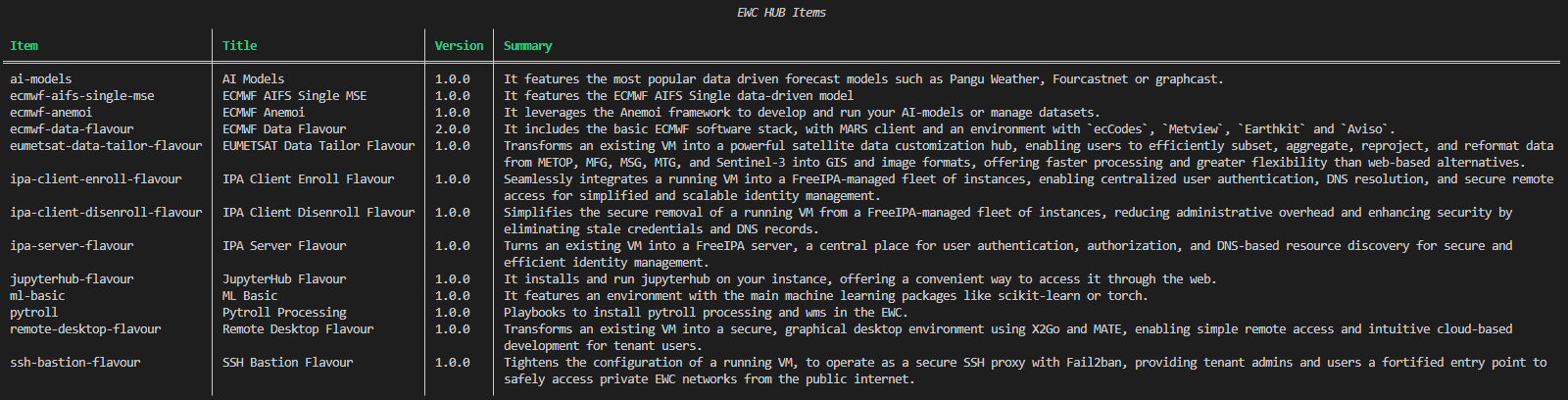
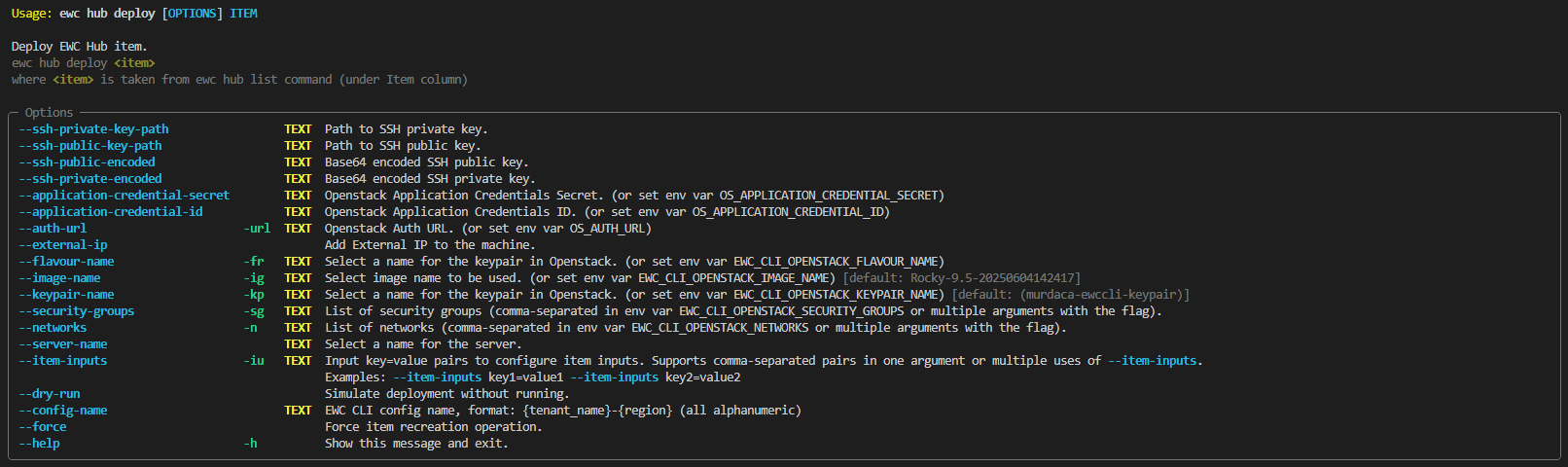
ewc hub deploy ITEMwhere ITEM is taken from ewc hub list command under Item column.
If you want to test the deployment of a new item, not yet published to EWC Community Hub, you can use the --path-to-catalog flag available.
For example you can create the following custom catalogue custom_catalogue.yaml with the following Ansible Playbook item (you can have more in case):
NOTE: Please verify the latest metadata needed for an item directly from the official EWC Hub Catalogue page available here.
apiVersion: communityhub.europeanweather.cloud/v1alpha1
kind: CommunityHubCatalog
spec:
  items:
    my-test-item:
      name: "my-test-item"
      version: "0.0.1"
      description: |
        My first item in EWC Community Hub

      ewccli:
        pathToMainFile: path_to_your_main_ansible_playbook_file
      home: https://github.com/your-repo
      sources:
        - https://github.com/your-repo.git OR /home/murdaca/custom-items/new-item
      maintainers:
        - name: your name or your org
          email: youremail
          url: https://github.com/your-repo/issues
      icon: https://raw.githubusercontent.com/ewcloud/ewc-community-hub/refs/heads/main/logos/EWCLogo.png
      annotations:
        technology: "Ansible Playbook"
        category: "Test Item"
        supportLevel: "Community"
        licenseType: "Apache License 2.0"
        others: "Deployable,EWCCLI-compatible"
      displayName: My First EWC Community hub item
      summary: My test item
      license: https://github.com/your-repo/blob/main/LICENSE
      published: true
where sources can be (only the first element in the list is considered):
- Public repo URL (e.g. https://github.com/your-repo.git) if your repository is public already
- Absolute path to a directory with the item (e.g. /home/murdaca/custom-items/new-item). The path needs to point to a directory that needs to exists an not be empty. (WARNING: No local path are accepted!)
Once ready you can try the following commands:
ewc hub --path-to-catalog PATH-TO-CATALOG list|show|deploywhere PATH-TO-CATALOG is by default the official published catalog available here.
list|show|deploy commands work the same, but they will rely on a custom catalogue file.
This section described the backends used and which commands are backed by those backends.
Used by infra and hub subcommands.
Used by hub subcommand.
Used by hub subcommand. (COMING SOON)
Used by dns, s3, k8s subcommmands. (COMING SOON)
The following dependencies are not included in the package but they are required and will be downloaded at build or compilation time:
| Dependency | Version | License | Home URL |
|---|---|---|---|
| requests | 2.32.5 | Apache Software License (Apache-2.0) | https://requests.readthedocs.io/en/latest |
| click | 8.1.8 | BSD-3-Clause | https://github.com/pallets/click |
| rich | 14.1.0 | MIT License | https://github.com/Textualize/rich |
| rich-click | 1.8.9 | MIT License | https://pypi.org/project/rich-click |
| prompt_toolkit | 3.0.51 | BSD-3-Clause License | https://python-prompt-toolkit.readthedocs.io/en/stable |
| pyyaml | 6.0.2 | MIT License | https://pyyaml.org |
| cryptography | 45.0.6 | Apache-2.0 OR BSD-3-Clause | https://github.com/pyca/cryptography |
| python-openstackclient | 8.2.0 | Apache Software License (Apache-2.0) | https://docs.openstack.org/python-openstackclient/latest |
| ansible | 11.10.0 | GNU General Public License v3 or later (GPLv3+) (GPL-3.0-or-later) | https://www.redhat.com/en/ansible-collaborative |
| ansible-runner | 2.4.1 | Apache Software License (Apache Software License, Version 2.0) | https://ansible.readthedocs.io/projects/runner/en/latest |
| kubernetes | 33.1.0 | Apache Software License (Apache License Version 2.0) | https://github.com/kubernetes-client/python |
| pydantic | 2.12.5 | MIT License | https://github.com/pydantic/pydantic |
The following dependencies are only required for building/editing/testing the software:
| Dependency | Version | License | Home URL |
|---|---|---|---|
| pytest | 8.4.1 | MIT License (MIT) | https://docs.pytest.org/en/latest |
| pytest-html | 4.1.1 | MIT License (MIT) | https://github.com/pytest-dev/pytest-html |
| pytest-mock | 3.14.1 | MIT License (MIT) | https://github.com/pytest-dev/pytest-mock |
| coverage | 7.10.5 | Apache Software License (Apache License Version 2.0) | https://github.com/nedbat/coveragepy |
| pre-commit | 4.3.0 | MIT License (MIT) | https://github.com/pre-commit/pre-commit |
| sphinx | 8.1.3 | BSD-2-Clause License | https://www.sphinx-doc.org/en/master |
| sphinx-click | 6.0.0 | MIT License (MIT) | https://github.com/click-contrib/sphinx-click |
| sphinx-rtd-theme | 3.0.2 | MIT License (MIT) | https://sphinx-rtd-theme.readthedocs.io/en/stable |
| pydeps | 3.0.1 | BSD-2-Clause License | https://github.com/thebjorn/pydeps |
All notable changes (i.e. fixes, features and breaking changes) are documented in the CHANGELOG.md.
Thanks for taking the time to join our community and start contributing!
Please make sure to:
-
Familiarize yourself with our Code of Conduct before contributing.
-
See CONTRIBUTING.md for instructions on how to request or submit changes.
- Fork this repository and move into it
git clone https://github.com/ewcloud/ewccli.git && cd ewccli- Install the package for testing
pip install --user -e .[test]-
Modify the local code and test changes.
-
When you are happy, push code to your fork and open a MR (Gitlab) or PR (Github)
sphinx-build -b html docs/source/ Documentation/coverage run -m pytestpytestAfter cloning the repository and cd into it.
- Create the .dist/ repo
pip install -q buildpython3 -m build- Create a container if you need to test anything before.
podman build -t test-ewccli -f ./Containerfile .or same command with docker if you use it.