
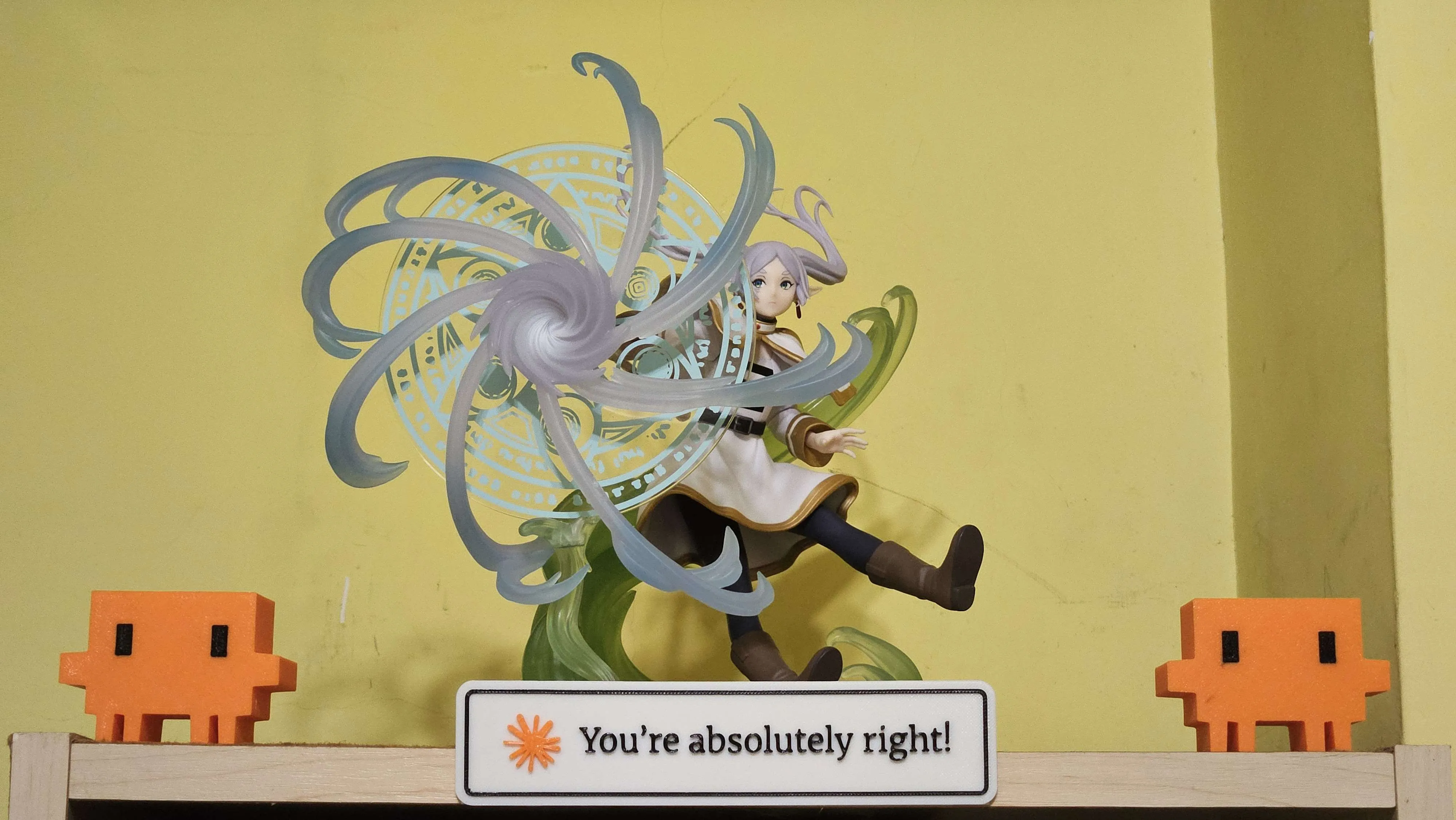
Two Claude Code avatars standing guard. Frieren mid-cast. "You're absolutely right!" — a reminder to trust, but verify.
Agentic AI experiments, tools, and battle-tested infrastructure — built on the belief that real work gets done when AI agents roam free.
I consider agentic AI as a torque wrench — the longer the arm, the more output per unit of human input.
| Mode | Leverage | Verdict |
|---|---|---|
| Copilot (autocomplete) | ~2:1 | Positively quaint |
| Agentic AI with human approval | ~5:1 | Still not very impressive |
| Autonomous agentic AI | >>10:1 | This is where real work gets done |
Another observation: technology always predates security. Before operating systems had memory integrity and protection rings, the answer was one machine per task. Before firewalls existed, the firewall was a closed door behind an air-gapped server room.
As such, I apply these principles to AI agents:
- Trust through containment — dedicated hardware per task, so damage is bounded to one cheap node
- Safe task assignment — give agents tasks where mistakes are recoverable
- Quality implementations — use robust agentic frameworks (Claude Code) over fragile alternatives
- Shared memory — agents across the fleet share knowledge so every session builds on the last
The result: a fleet of bare-metal nodes where AI agents fight rich battles — real SSH, real tools, real autonomy — while I set direction and review outcomes. Battles which other AI agents have hardly fought before.
| Repository | Description |
|---|---|
| corrupted-windows | Righting a cursed Windows install — four cascading root causes, a $11 DIY IPKVM, and an AI agent that spent two days reading CBS logs until the update finally persisted |
| dmr39 | Reverse-engineering a 2016 set-top box with no API — 27 failed I2C strategies, an IR pivot, and 41 buttons mapped via NEC protocol, all built by an AI agent overnight |
| minibook-x | Installing Kubuntu on a Chuwi MiniBook X entirely over SSH — no USB boot, no installer, just Python writing a raw ext4 image to an NVMe partition from Windows |
| q506 | Fixing a Fujitsu Q506 tablet's broken touchscreen — 23 dead ends, raw MMIO register manipulation, and one GPIO bit, all via SSH while the human touched the screen on command |
| ssd | Firmware updates and SMART monitoring for every SSD in a multi-node homelab — four Lenovo OEM drives flashed, three methods, zero bricks |
Multi-session agentic projects where AI agents return again and again — building on shared memory, accumulated knowledge, and human direction. These aren't one-shot battles — they're campaigns.
| Repository | Description |
|---|---|
| lightsword | Running x86-64 Linux inside Safari on iOS — BusyBox with 365+ applets, native ARM64 JIT at 91 MIPS, and syscall translation, built across multiple agentic sessions |
| maimai | AI-powered chart pattern detection for maimai — 9 structural detectors, 97% accuracy on Umiyuri, 1,717 charts analyzed across 13+ hours of agentic TDD |
| Repository | Description |
|---|---|
| memory-share | Claude Code skill for synchronizing AI agent memory across a multi-node homelab — AI-powered merge, no cron, no single point of failure |
| homelab-dashboard | Homelab monitoring dashboard and agent message board on a 9.7" color e-paper screen — REST API, NiceGUI web UI, Claude usage tracking |
| claude-code-time-awareness | Time awareness hook for autonomous Claude Code agents — injects current time into agent context via PostToolUse, so long-running sessions know when to stop |
| Repository | Description |
|---|---|
| claude-code-audio-tap-classifier | Percussive event classification: drum hit clustering and scaffolding tap-test classifier |
| claude-code-cv-demo | CV demo: YOLO26, Gemini 3 Flash, background removal |
| Repository | Description |
|---|---|
| NIKI | 1st Runner Up & Best Presentation Award — Cathay Hackathon 2025 |
Part of the evnchn project family.