






This is a pytest plugin that enables you to test your code that relies on a running Redis database. It allows you to specify additional fixtures for Redis process and client.
- Install the plugin and your test dependencies (as you normally do for your project).
- Ensure Redis is available (local install or container). The
redis-serverexecutable must be on PATH, or pass it explicitly with--redis-exec. If Redis can't be found or started, pytest-redis raisesRedisMisconfigured. - Create a test that uses the built-in fixture:
def test_can_connect(redisdb):
    redisdb.set("ping", "pong")
assert redisdb.get("ping") == b"pong"- Run your tests:
pytestThe plugin contains three fixtures:
- redisdb - function-scoped client fixture that cleans all databases after each test.
- redis_proc - session-scoped fixture that starts Redis at first use and stops at the end of the tests.
- redis_noproc - no-process fixture that connects to an already running Redis instance.
Simply include one of these fixtures in your test fixture list.
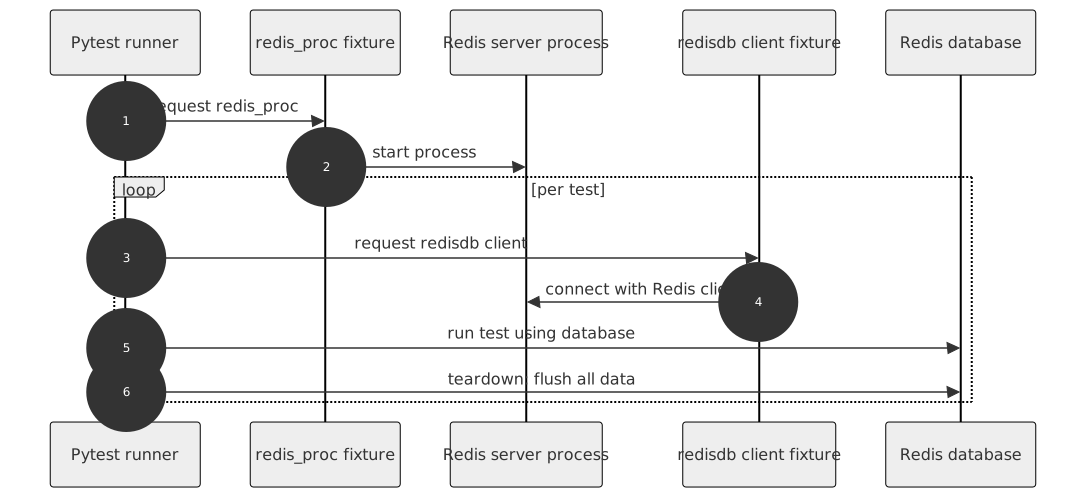
#
def test_redis(redisdb):
    """Check that it's actually working on redis database."""
    redisdb.set('test1', 'test')
    redisdb.set('test2', 'test')

    my_functionality = MyRedisBasedComponent()
    my_functionality.do_something()
    assert my_functionality.did_something

    assert redisdb.get("did_it") == 1
The example above works as follows:
- pytest runs tests
- redis_proc starts redis database server
- redisdb creates client connection to the server
- test itself runs and finishes
- redisdb cleans up the redis
- redis_proc stops server (if that was the last test using it)
- pytest ends running tests
You can also create additional redis client and process fixtures if you need to:
from pytest_redis import factories

redis_my_proc = factories.redis_proc(port=None)
redis_my = factories.redisdb('redis_my_proc')

def test_my_redis(redis_my):
    """Check that it's actually working on redis database."""
    redis_my.set('test1', 'test')
    redis_my.set('test2', 'test')

    my_functionality = MyRedisBasedComponent()
    my_functionality.do_something()
    assert my_functionality.did_something

    assert redis_my.get("did_it") == 1
Note
Each Redis process fixture can be configured in a different way than the others through the fixture factory arguments.
Some projects use already running Redis servers (i.e. on Docker instances).
In order to connect to them, one would be using the redis_noproc fixture.
redis_external = factories.redisdb('redis_noproc')

def test_redis(redis_external):
    """Check that it's actually working on redis database."""
    redis_external.set('test1', 'test')
    redis_external.set('test2', 'test')

    my_functionality = MyRedisBasedComponent()
    my_functionality.do_something()
    assert my_functionality.did_something

    assert redis_external.get("did_it") == 1
Standard configuration options apply to it. Note that the modules configuration option
has no effect with the redis_noproc fixture, it is the responsibility of the already
running redis server to be properly started with extension modules, if needed.
By default the redis_noproc fixture would connect to Redis
instance using 6379 port attempting to make a successful socket
connection within 15 seconds. The fixture will block your test run
within this timeout window. You can overwrite the timeout like so:
# set the blocking wait to 5 seconds
redis_noproc = factories.redis_noproc(startup_timeout=5)
redis_external = factories.redisdb('redis_noproc')

def test_redis(redis_external):
    """Check that it's actually working on redis database."""
    redis_external.set('test1', 'test')
    # etc etc
These are the configuration options that are working on all levels with the redis_noproc fixture:
You can define your settings in three ways, it's fixture factory argument, command line option and pytest.ini configuration option. You can pick which you prefer, but remember that these settings are handled in the following order:
Fixture factory argumentCommand line optionConfiguration option in your pytest.ini file
| Redis server option | Fixture factory argument | Command line option | pytest.ini option | Noop process fixture | Default |
|---|---|---|---|---|---|
| executable | executable | --redis-exec | redis_exec | Look in PATH for redis-server via shutil.which | |
| host | host | --redis-host | redis_host | host | 127.0.0.1 |
| port | port | --redis-port | redis_port | port | random |
| Free port search count | port_search_count | --redis-port-search-count | redis_port_search_count | 5 | |
| username | username | --redis-username | redis_username | username | None |
| password | password | --redis-password | redis_password | password | None |
| connection timeout | timeout | --redis-timeout | redis_timeout | 15 | |
| number of databases | db_count | --redis-db-count | redis_db_count | 8 | |
| Whether to enable logging to the system logger | syslog | --redis-syslog | redis_syslog | False | |
| Redis log verbosity level | loglevel | --redis-loglevel | redis_loglevel | notice | |
| Compress dump files | compress | --redis-compress | redis_compress | True | |
| Add checksum to RDB files | checksum | --redis-rdbcompress | redis_rdbchecksum | False | |
| Save configuration | save | --redis-save | redis_save | "" | |
| Redis test instance data directory path | datadir | --redis-datadir | redis_datadir | "" | |
| Redis test instance extension module(s) path | modules (list of paths) | --redis-modules (comma-separated string) | redis_modules (comma-separated string) | "" |
Example usage:
- pass it as an argument in your own fixture
redis_proc = factories.redis_proc(port=8888)- use
--redis-portcommand line option when you run your tests
py.test tests --redis-port=8888specify your port as
redis_portin yourpytest.inifile.To do so, put a line like the following under the
[pytest]section of yourpytest.ini:
[pytest]
redis_port = 8888
Options below are for configuring redis client fixture.
| Redis client option | Fixture factory argument | Command line option | pytest.ini option | Default |
|---|---|---|---|---|
| decode_response | decode | --redis-decode | redis_decode | False |
Install pipenv and --dev dependencies first, Then run:
pipenv run tbump [NEW_VERSION]