ISO 8559-1 body measurements for Anny and MHR parametric body models. Six keys are differentiable through PyTorch autograd for gradient-based body fitting.
Anny and MHR give you a 14–18K vertex mesh and nothing to measure it with. SMPL tooling doesn't port over, and the plane-sweep algorithms look simple until you hit convex-hull tape simulation, contour-fragment merging, and ISO-compliant landmark detection for bust/hip/crotch. clad-body is that work, done once — 25 anthropometric measurements over circumferences, lengths, and body composition (volume, mass, BMI, body fat), calibrated against real scan data. It's used in production at Clad for size-aware virtual try-on.
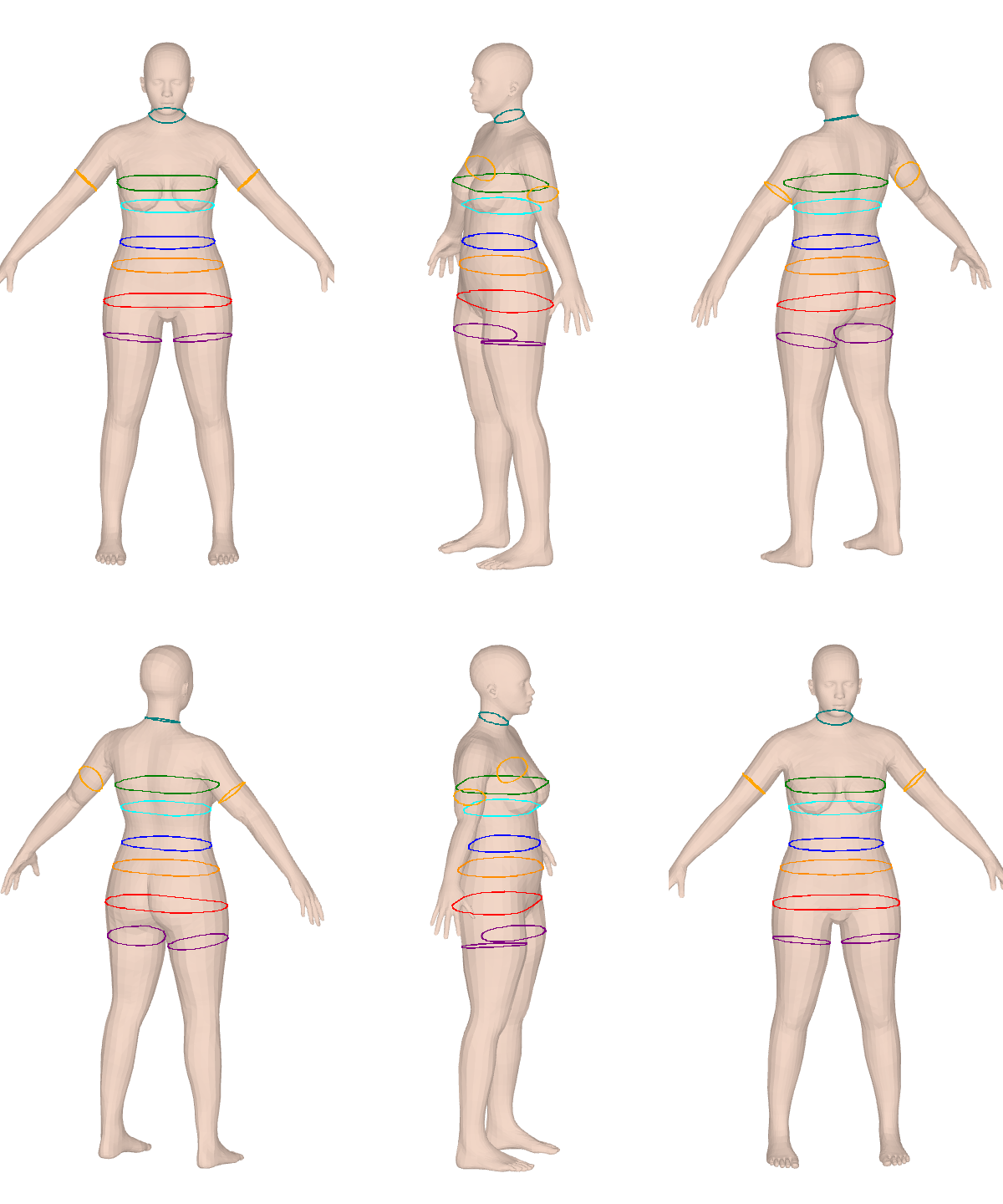
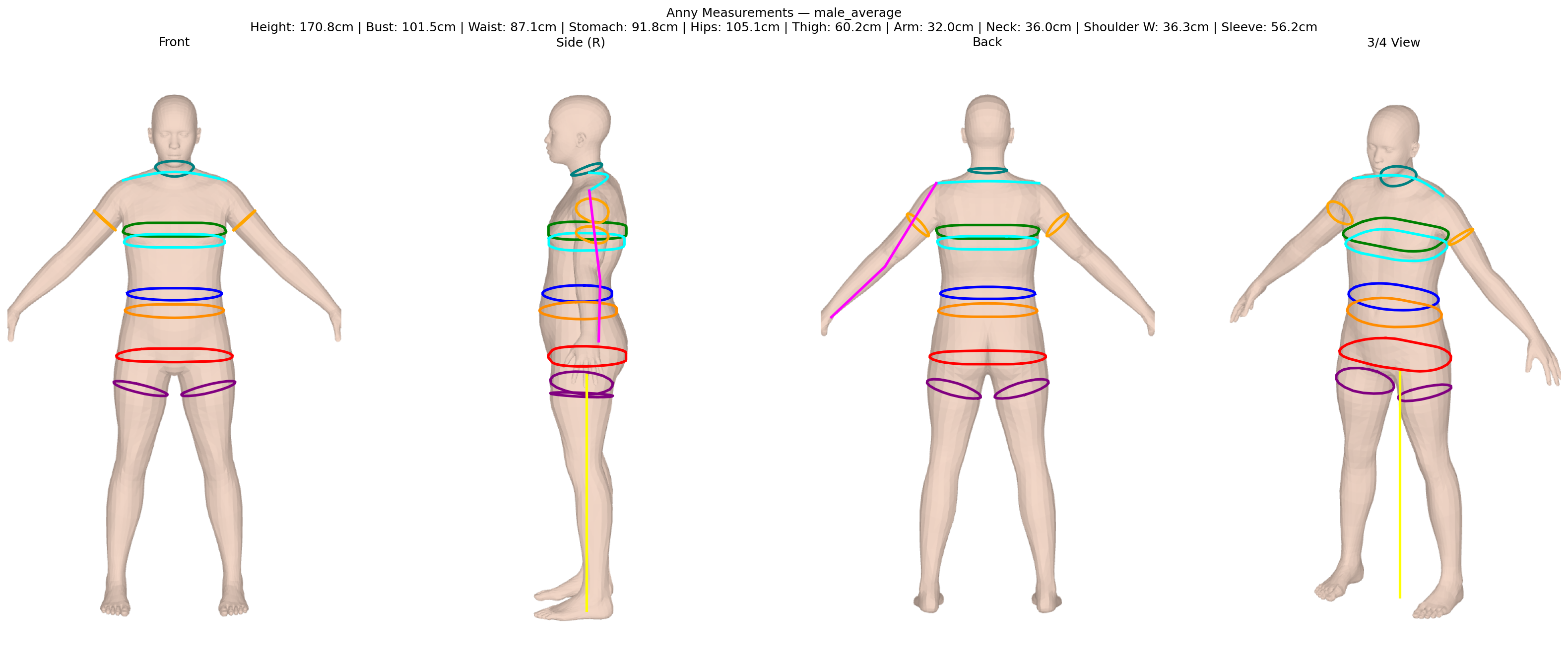
All bodies are normalised to the same coordinate convention: Z-up, metres, XY-centred, feet at Z=0, +Y=front.
pip install clad-body

# With Anny body loader (requires torch)
pip install 'clad-body[anny]'

# With MHR body loader (requires pymomentum)
pip install 'clad-body[mhr]'

# With 4-view rendering
pip install 'clad-body[render]'from clad_body.load import load_anny_from_params
from clad_body.measure import measure
body = load_anny_from_params(params)
m = measure(body) # all measurements
m = measure(body, preset="core") # 4: height, bust, waist, hip
m = measure(body, preset="standard") # 9: + thigh, upperarm, shoulder, sleeve, inseam
m = measure(body, preset="tops") # garment-relevant subset
m = measure(body, only=["bust_cm", "hip_cm"]) # specific keys
m = measure(body, tags={"type": "circumference", "region": "leg"}) # tag filter
m = measure(body, render_path="body.png") # with 4-view renderMHR works the same way:
from clad_body.load import load_mhr_from_params
body = load_mhr_from_params("path/to/sam3d_params.json")
m = measure(body)Under active development. API surface and supported keys may change between minor versions. Six keys are differentiable today; more will follow.
For autograd-based optimization of the body mesh, use measure_grad(body) instead of measure(body). Same input, same key names — but the returned values are PyTorch tensors with autograd history, so you can put them directly into a loss and backprop into the Anny phenotype parameters.
Pass requires_grad=True to load_anny_from_params to create the body with gradient-enabled phenotype tensors (stored on body.phenotype_kwargs):
import torch
from clad_body.load import load_anny_from_params
from clad_body.measure import measure_grad

body = load_anny_from_params(initial_params, requires_grad=True)
optimizer = torch.optim.Adam(list(body.phenotype_kwargs.values()), lr=0.01)

for step in range(500):
    optimizer.zero_grad()
    m = measure_grad(body, only=["waist_cm", "inseam_cm"])
    loss = (m["waist_cm"] - 78.0) ** 2 + (m["inseam_cm"] - 82.0) ** 2
    loss.backward()
    optimizer.step()
Each measure_grad(body) call re-runs the forward pass using body.phenotype_kwargs, so after optimizer.step() updates the tensors the next iteration measures the new mesh. If you only want to optimize a subset of parameters, load without requires_grad=True and enable it per-tensor: body.phenotype_kwargs["height"].requires_grad_(True).
Supported keys and their calibration error vs the ISO reference that measure() uses:
| Key | Error vs ISO |
|---|---|
height_cm, waist_cm |
exact (same loop / extent) |
inseam_cm |
RMS 0.06 cm, max 0.10 cm |
sleeve_length_cm |
RMS 0.33 cm, max 0.55 cm |
upperarm_cm |
≤ 1 cm |
thigh_cm |
broken — gradient direction only (vertex loop under-reports by 3–6 cm; use measure() for reporting) |
Requesting any other key raises ValueError. There is no silent numpy fallback — it would break gradient flow without warning. For non-differentiable keys use measure().
| Import | What |
|---|---|
clad_body.load.load_anny_from_params |
Load Anny body from phenotype params |
clad_body.load.load_mhr_from_params |
Load MHR body from SAM 3D Body params |
clad_body.load.AnnyBody, MhrBody |
Body dataclasses |
clad_body.measure.measure |
Measure a body (numpy reporting path, ISO 8559-1) |
clad_body.measure.measure_grad |
Differentiable measurements for autograd loops (Anny only) |
clad_body.measure.REGISTRY |
All measurement definitions (dict[str, MeasurementDef]) |
clad_body.measure.list_measurements |
Query measurements by tags |
clad_body.measure.MeasurementDef |
Measurement definition type |
measure() accepts preset, only, tags, exclude. Precedence: only > preset > tags > default ("all"). exclude is applied last. Only runs computation groups needed for the requested keys.
from clad_body.measure import REGISTRY, list_measurements

REGISTRY["bust_cm"].description   # self-measurement instructions
REGISTRY["bust_cm"].iso_ref       # "5.3.4"
REGISTRY["bust_cm"].type          # "circumference"

list_measurements(type="circumference", region="leg") # [thigh, knee, calf]Every measurement is tagged across 5 dimensions. Each carries a human-readable description for self-measurement instructions and i18n key mapping.
| Dimension | Values |
|---|---|
| type | circumference, length, scalar |
| standard | iso (ISO 8559-1), tailor (industry standard), derived (computed) |
| region | neck, torso, abdomen, arm, leg, full_body |
| tier | core > standard > enhanced > fitted (cumulative) |
| garments | tops, bottoms, dresses, outerwear, underwear |
| Preset | Count | Adds |
|---|---|---|
core |
4 | height, bust, waist, hip |
standard |
9 | thigh, upperarm, shoulder_width, sleeve_length, inseam |
enhanced |
18 | neck, underbust, stomach, mass, volume, bmi, body_fat, belly_depth, back_neck_to_waist |
fitted/all |
25 | knee, calf, wrist, crotch_length, front_rise, back_rise, shirt_length |
Garment codes: Tops, Bottoms, Dresses, Outerwear, Underwear.
| Contour | Key | Description | ISO | Type | Std | Region | Tier | Grp | Gar |
|---|---|---|---|---|---|---|---|---|---|
 |
height_cm |
Vertical distance from floor to top of head. Stand erect, feet together. | 5.1.1 | scalar | iso | full_body | core | A | all |
|
bust_cm |
Horizontal circumference at the fullest part of the chest/bust. Tape under armpits, across bust prominence, level and snug. | 5.3.4 | circ | iso | torso | core | A | T,D,O,U |
 |
waist_cm |
Horizontal circumference at natural waist, midway between lowest rib and hip bone. Tape at navel height, parallel to floor. | 5.3.10 | circ | iso | torso | core | A | all |
 |
hip_cm |
Horizontal circumference at greatest buttock prominence. Feet together, tape around widest part of hips. | 5.3.13 | circ | iso | abdomen | core | A | B,D,O,U |
 |
thigh_cm |
Horizontal circumference at fullest part of upper thigh, just below gluteal fold. Stand with legs slightly apart. | 5.3.20 | circ | iso | leg | std | B | B |
 |
upperarm_cm |
Circumference at fullest part of upper arm, midway between shoulder and elbow. Arm relaxed, not flexed. | 5.3.16 | circ | iso | arm | std | B | T,O |
 |
shoulder_width_cm |
Distance between left and right shoulder points (acromion), measured across back over C7 vertebra. | 5.4.2 | length | iso | torso | std | C | T,D,O |
 |
sleeve_length_cm |
Distance from shoulder point along outside of slightly bent arm, over elbow, to wrist bone. (ISO §5.4.14 + §5.4.15 outer arm length, computed via plane-slice surface walk on rest pose; differentiable runtime is bone chain + linear correction.) | 5.7.8 | length | iso | arm | std | C | T,O |
 |
inseam_cm |
Distance from crotch point straight down to floor. Stand erect, feet slightly apart. | 5.1.15 | length | iso | leg | std | E | B |
 |
neck_cm |
Circumference just below Adam's apple, perpendicular to neck axis. Comfortably snug. | 5.3.2 | circ | iso | neck | enh | D | T |
 |
underbust_cm |
Horizontal circumference directly below breast tissue, at inframammary crease. Bra band size. | 5.3.6 | circ | iso | torso | enh | A | T,D,U |
 |
stomach_cm |
Horizontal circumference at maximum anterior protrusion of abdomen, usually at/below navel. | -- | circ | tailor | abdomen | enh | A | T,B |
mass_kg |
Total body mass in kilograms. | 5.6.1 | scalar | iso | full_body | enh | G | -- | |
volume_m3 |
Total body volume in cubic metres, from mesh geometry. | -- | scalar | derived | full_body | enh | G | -- | |
bmi |
Body mass index: mass (kg) / height (m)^2. | -- | scalar | derived | full_body | enh | G | -- | |
body_fat_pct |
Estimated body fat % via Navy/Weltman equations from circumferences. | -- | scalar | derived | full_body | enh | G | -- | |
belly_depth_cm |
How much belly protrudes forward vs underbust/ribcage. Negative = belly prominence. | -- | scalar | derived | abdomen | enh | A | T,B | |
 |
knee_cm |
Horizontal circumference at centre of kneecap. Bend knee slightly (~45 degrees). | 5.3.22 | circ | iso | leg | fit | B | B |
 |
calf_cm |
Maximum horizontal circumference of the calf. Stand with legs slightly apart. | 5.3.24 | circ | iso | leg | fit | B | B |
 |
wrist_cm |
Circumference at wrist, at prominent bone on little finger side (ulnar styloid). | 5.3.19 | circ | iso | arm | fit | D | T |
 |
crotch_length_cm |
Distance from front waist centre, through crotch, to back waist centre. Follow body surface. | 5.4.18 | length | iso | leg | fit | E | B |
front_rise_cm |
Front waist to crotch point, along front body surface. Trouser front panel length. | -- | length | tailor | leg | fit | E | B | |
back_rise_cm |
Back waist to crotch point, along back body surface. Trouser back panel length. | -- | length | tailor | leg | fit | E | B | |
 |
shirt_length_cm |
Side neck point down along front body contour to crotch level. Follow chest/stomach curve. | -- | length | tailor | torso | fit | F | T |
 |
back_neck_to_waist_cm |
Cervicale (C7) down centre back along body contour to waist level. Tape follows spine curvature. | 5.4.5 | length | iso | torso | enh | H | T,D,O |
Tier codes: core, std (standard), enh (enhanced), fit (fitted). Anny-only: underbust, mass, volume, bmi, body_fat, belly_depth.
| Group | Measurements | Cost | Deps |
|---|---|---|---|
| A Core torso | height, bust, waist, hip, stomach, underbust, belly_depth | Cheap | -- |
| B Limb sweeps | thigh, knee, calf, upperarm | Expensive | -- |
| C Joint linear | shoulder_width, sleeve_length (ISO surface walk on re-posed body) | Very expensive | -- |
| D Perpendicular | neck, wrist | Medium | -- |
| E Mesh geometry | inseam (mesh sweep), crotch_length, front_rise, back_rise | Medium | -- |
| F Surface trace | shirt_length | Medium | E |
| G Body composition | volume, mass, bmi, body_fat | Cheap | D |
| H Back length | back_neck_to_waist | Cheap | A |
Group C and E have differentiable alternatives in measure_grad — use it for hot-loop optimization instead of calling measure() repeatedly.
measure() only runs the computation groups needed for the requested keys — use only= or preset= to skip expensive groups:
measure(body)                         # all groups — ~800 ms
measure(body, preset="core")          # group A only — ~100 ms
measure(body, only=["bust_cm"])       # group A only — ~100 ms
measure(body, only=["shoulder_width_cm"]) # groups A + C — ~200 msmeasure() accepts a device parameter (None = auto-detect CUDA):
measure(body, only=["bust_cm"], device="cuda")  # GPU forward pass
measure(body, device=None) # auto: CUDA if available| Extra | What it enables |
|---|---|
[anny] |
Anny body loader (requires torch) |
[mhr] |
MHR body loader (requires pymomentum) |
[render] |
4-view body renders (requires matplotlib, pyrender) |
Without extras, only numpy, scipy, and trimesh are required.
Try the full pipeline at clad.you/size-aware/size-me.
This library was built for Clad's size-aware virtual try-on pipeline. Read the full story: A 3D Body Scan for Nine Cents — Without SMPL.
Apache 2.0 — see LICENSE.