Releases: RamiBotAI/ramibot
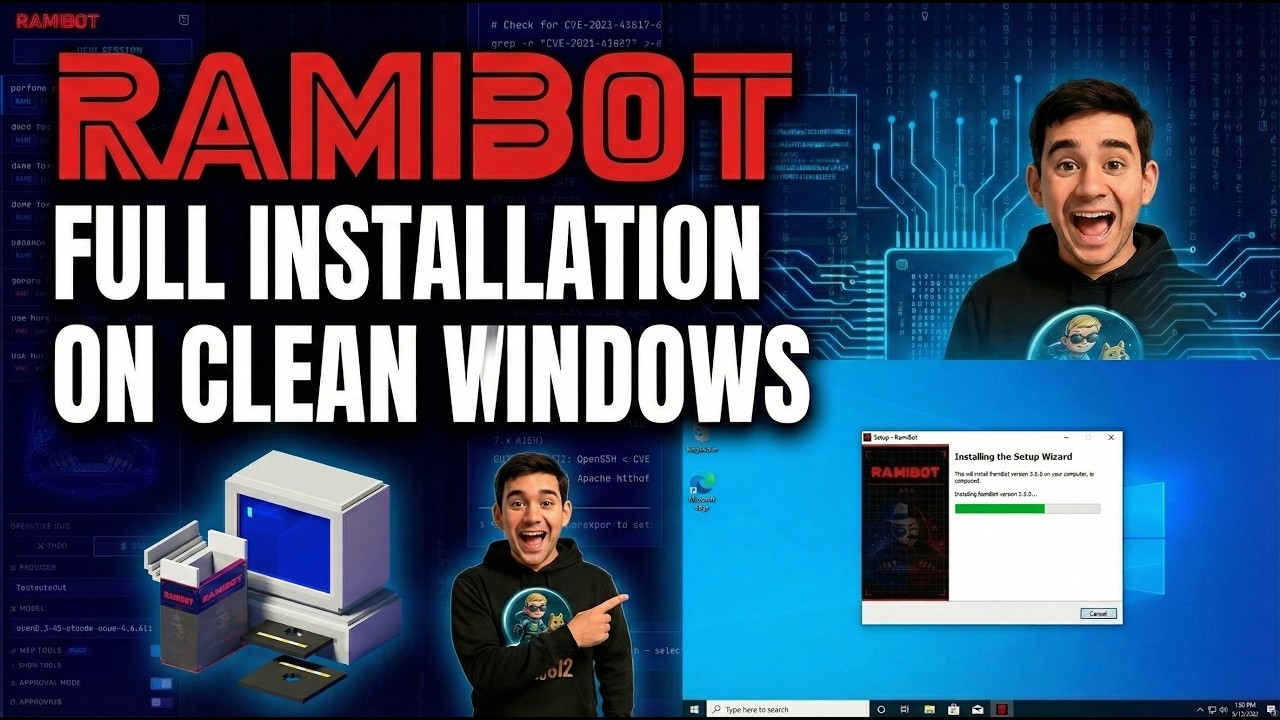
RamiBot v3.8.0 – Installer + Setup Experience

🚀 Installation Experience Update
🚀 RamiBot v3.8.0 introduces a full installation experience from a clean system.
From zero to a fully operational cybersecurity environment — guided, reproducible, and accessible.
✨ Highlights
- 🎥 Full installation demo (clean Windows environment)
- 🛠️ Inno Setup installer configuration added
- ⚙️ Setup scripts (Windows & Linux)
- 🎨 UI improvements
- 🐳 Updated Docker configuration
🎥 Full Installation Demo (Windows)
⚠️ Notes
- First run may take ~15–20 minutes (container creation)
- Next runs are significantly faster
🎯 Why this matters
Setting up a cybersecurity environment is often complex and time-consuming.
RamiBot reduces that friction by guiding the process and preparing a ready-to-use environment.
⭐ If you find RamiBot useful, consider starring the repository.
RamiBot v3.7.3 — OAuth Token Authentication for OpenAI Codex and Anthropic
What's new in v3.7.3
OpenAI OAuth Token (ChatGPT Plus/Pro subscription)
- RamiBot can now authenticate with OpenAI using the OAuth token from the Codex CLI (
~/.codex/auth.json) instead of
a platform API key - Routes requests to
chatgpt.com/backend-api/codex/responses— uses your ChatGPT subscription instead of pay-per-use
billing - Account ID extracted automatically from the JWT — no manual configuration
- Static model list: GPT-5.2 Codex, GPT-5.1 Codex Max, GPT-5.1 Codex, GPT-5.1 Codex Mini, GPT-5.2, GPT-5.1, GPT-5
- Full tool calling and streaming support via the Responses API SSE protocol
- Set the
access_tokenfrom~/.codex/auth.jsonin Settings → API Keys → OpenAI OAuth Token
Anthropic OAuth Token (reserved)
- OAuth token field added for Anthropic (
sk-ant-oat01-*format validation) - Currently non-functional — Anthropic blocked third-party OAuth access in February 2026
- Infrastructure is in place and will activate automatically when Anthropic re-enables it
Settings UX
- Saving settings now automatically refreshes the model list — no need to reload the page or re-select the provider
after entering new credentials
v3.7.2 — Service-Bound CVE Correlation & NVD 2.0 API
What's new in v3.7.2
Service-Bound CVE Correlation
Each CVE returned by cve_lookup now includes a SERVICE BINDING line derived from
CPE data, naming the exact vendor/product the CVE applies to. A global rule
(EVIDENCE_RULES rule 9) enforces that every CVE in a report or analysis is attached
only to the matching detected service — never reassigned to an unrelated service on the
same host.
CVE Query Lock
A new global rule (EVIDENCE_RULES rule 10) prevents the LLM from drifting when building
cve_lookup queries after service discovery. Queries must be derived strictly from
the detected product name and version string present in tool output. Forbidden inputs:
host IP, semantic pivots to adjacent software (Apache ≠ Log4j), and famous CVEs
introduced from background knowledge without a confirmed product match. The rule is
reinforced at skill level in both recon and analysis.
Expanded cve_lookup — Full NVD 2.0 API support
The tool now exposes the complete NVD 2.0 API parameter set:
| Parameter | Description |
|---|---|
keyword + exact_match |
Whole-word keyword matching |
cpe_name |
Filter by full CPE 2.3 string |
virtual_match_string |
CPE pattern/wildcard matching |
cvss_severity |
Filter by LOW / MEDIUM / HIGH / CRITICAL |
pub_start_date / pub_end_date |
Publication date range |
last_mod_start_date / last_mod_end_date |
Last-modified date range |
no_rejected |
Exclude REJECT-status CVEs |
The knowledge file (rami-kali/knowledge/tools/cve_lookup.md) has been fully rewritten
with a parameter table, 8 invocation examples, and the CVE Query Lock decision
sequence.
Files changed
rami-kali/mcp_server.py · backend/skills/composer.py ·
backend/skills/definitions/recon.json · backend/skills/definitions/analysis.json ·
backend/skills/definitions/reporting.json · rami-kali/knowledge/tools/cve_lookup.md
· README.md · rami-kali/README.md
RamiBot v3.7.1 — CVE Intelligence via NVD API
What's new in v3.7.1
cve_lookup — CVE Intelligence Tool
New MCP tool that queries the NIST National Vulnerability Database (NVD)
in real time from inside the rami-kali container.
Capabilities:
- Look up any CVE by ID (e.g.
CVE-2021-44228) — returns CVSS score,
severity, description, affected CPEs and references - Keyword search by product/version (e.g.
apache log4j 2.14) with
configurable result limit (1–20) - No binary required — uses Python stdlib
urllib, always available
Evidence integration:
- Full Evidence Gate support:
has_findings: truewith verified CVE ID,
CVSS score and status as confirmed facts - Dedicated knowledge base at
knowledge/tools/cve_lookup.mdwith NVD
query strategy, CVSS bands, evidence rules and chaining workflows - Chains naturally with
searchsploit_queryandnuclei_scan:
nmap discovers version → cve_lookup enriches → searchsploit finds exploit
Total active MCP tools: 45
RamiBot v3.7 — zsh shell, proxychains4, and expanded toolset
What's new in v3.7
### rami-kali
- zsh by default — syntax highlighting (green/red feedback) and autosuggestions (arrow-up / →) in the Docker terminal - proxychains4 with two ready-made profiles: Burp (
/etc/proxychains4.conf) and Tor (/etc/proxychains4-tor.conf) - New pentest tools:
masscan,ffuf,nuclei,theHarvester - gobuster_dir now accepts a
proxyparameter for direct Burp/Tor routing - QoL packages:
nano,vim-tiny,tmux,jq,socat,net-tools,lsof,procps, and more
Backend
terminal.pyshell detection now prefers zsh → bash → sh
RamiBot v3.6 -- Burp Suite skill, language selector, and Hermes tool chaining
Release 3.6
New
-
burp_expert skill — new skill for web application assessment via Burp Suite MCP:
staged workflow (traffic generation → proxy history → request crafting → fuzzing),
evidence discipline rules, and anti-XML tool execution enforcement -
Response language selector — choose LLM response language (Auto / ES / EN / FR / DE / PT / IT)
from Settings → Interface; removed from Sidebar
Improved
-
Hermes tool chaining — backend now detects and executes
<tool_call>XML emitted as plain
text by Hermes/Llama fine-tuned models; up to 8-hop tool loop with full tool schema per hop -
Tool name resolution — normalized lookup (full name + tool-part after
__) so model-output
names likeget_proxy_http_historycorrectly resolve torami-kali__get_proxy_http_history
Fixed
- Tor DNS startup race condition — Rami-Kali now waits for both
TransPort (9040)and
DNSPort (5353)before applying transparent proxy iptables rules, preventing DNS resolution
failures (Could not resolve host) during Tor initialization
Maintenance
- Repository line-ending normalization — enforced LF endings via
.gitattributesfor
cross-platform consistency (Docker / Linux environments)
RamiBot v3.5 — Deterministic Security Reporting
🚀 RamiBot v3.5.0
Deterministic Security Reporting
This release introduces strict evidence-based reporting across all modes.
Improvements
Evidence-locked analysis (tool output only)
No inferred vulnerabilities or severity inflation
Severity derived exclusively from confirmed scanner findings
Conditional risk language enforced
Internal reasoning fully isolated from reports and PDFs
Structured RAW → PARSED → INTERPRETATION separation
Outcome
RamiBot now produces deterministic, reproducible, and tool-grounded security reports.
Tag: v3.5.0
Commit: 57d5aa9
RamiBot v3.4 — Tool Approval Gate - PDF
What's new in v3.4
Tool Approval Gate (human-in-the-loop MCP)
RamiBot now supports an optional approval gate that pauses execution before every MCP tool call and waits for explicit
operator confirmation.
How it works:
- Enable MCP in the sidebar → the Approval Mode toggle appears
- Activate it — every tool call triggers an inline banner
- The banner shows: tool name, key arguments (
target,host,port…), a risk badge colored by level, and a
120 s countdown - Click APPROVE → tool runs normally; DENY → LLM receives
[TOOL EXECUTION DENIED BY USER]and responds
accordingly - No response in 120 s → auto-denied
Risk levels sourced from rami-kali/config.yaml → risk_levels:
| Level | Color | Examples |
|---|---|---|
low |
🟢 green | default |
medium |
🟡 amber | default for unlisted tools |
high |
🟠 orange | sqlmap, hydra, msf_console, mimikatz… |
critical |
🔴 red | configurable |
Edge cases covered: multiple tool calls per turn (sequential banners), Stop during approval, 120 s timeout
auto-deny, MCP-disabled hides the toggle.
Also included
reportPdf.js— browser-native PDF export for security reports- UI polish and findings improvements carried over from v3.3
Files changed
backend/main.pyfrontend/src/components/ToolApprovalBanner.jsx(new)frontend/src/components/ChatPanel.jsxfrontend/src/components/Sidebar.jsxfrontend/src/store.jsfrontend/src/reportPdf.js(new)README.md
v3.3.0 — Multi-Provider Tool Execution Stabilization
RamiBot v3.3.0
Release Date: 2026-02-27
🚀 Overview
Version 3.3.0 introduces major architectural improvements to multi-provider tool execution, enhanced timeout handling, and stronger error control mechanisms.
This release significantly improves stability, reliability, and provider abstraction consistency across the platform.
✨ Architecture Improvements
🔄 Multi-Provider Tool Format Normalization
Different LLM providers expect different tool execution formats.
v3.3.0 standardizes internal history handling while adapting per provider.
OpenAI / OpenRouter / LM Studio / Ollama
Follow-up history uses OpenAI-style format:
role: "assistant"withtool_callsarrayrole: "tool"withtool_call_id
This format is used internally as the canonical representation.
Anthropic
The method _convert_messages() in:
backend/adapters/anthropic_adapter.py
translates OpenAI-style tool messages into Anthropic-compatible format:
tool_useblockstool_resultblocks
Any new provider extending BaseAdapter must implement equivalent translation logic if its API does not accept OpenAI-style tool messages.
⏱ Timeout Adaptation
Improved handling of long-running tool executions:
- Better synchronization between backend execution time and LLM expectations
- Reduced premature timeouts
- More consistent follow-up behavior after delayed tool responses
🛠 Command Corrections
- Fixed inconsistencies in tool invocation flow
- Improved argument parsing
- Cleaner execution pipeline between
main.pyand adapters
🚨 Robust Error Handling
If a tool fails due to:
- Exception
- Timeout
- Execution error
The function:
_format_tool_content() (main.py)
injects an explicit failure notice:
[TOOL EXECUTION FAILED]
This ensures:
- The LLM reports real execution errors
- Fabricated tool outputs are prevented
- Output remains auditable and deterministic
🧠 Impact
- Improved multi-provider compatibility
- Reduced hallucinated tool responses
- Cleaner adapter abstraction layer
- Stronger foundation for future provider integrations
🔜 Forward Compatibility
The adapter architecture is now structured to support:
- Additional LLM providers
- Custom provider-specific message translation layers
- More advanced execution control in future major versions
End of v3.3.0
RamiBot v3.2.0 – Public Release
🚀 RamiBot v3.2.0
✨ New Features
Scope selection directly from UI
Persistent scope configuration
Docker container start/stop from frontend
⚙ Improvements
MCP stability improvements
UI enhancements
🐛 Fixes
Minor frontend fixes