This is a personal project where I'm learning to build a real-time simulation of celestial bodies using C++. It began as a simple 2D circle bouncing under gravity, modeled with basic kinematics. Since then, the simulation has evolved significantly: from kinematics to full Newtonian kinetics, and from 2D to 3D.
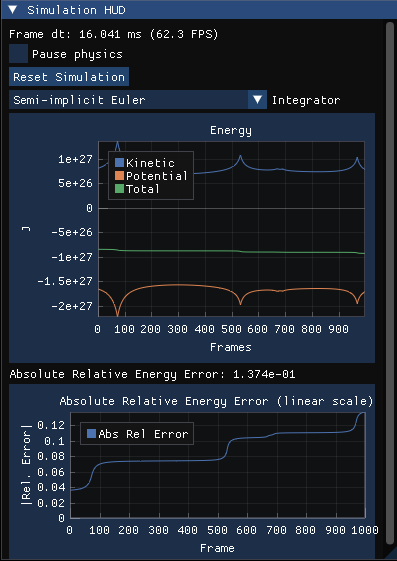
It now models gravitational interactions and perfectly elastic collisions between spherical objects, visualized in 3D using legacy OpenGL. A minimal GUI has been added to experiment with and observe the relative error of different numerical integrators. The GUI also includes controls for interacting with and managing the simulation at runtime.
This is my first attempt at building a full C++ application outside of university or academic exercises. Starting simple and steadily adding features and accuracy as I learn.
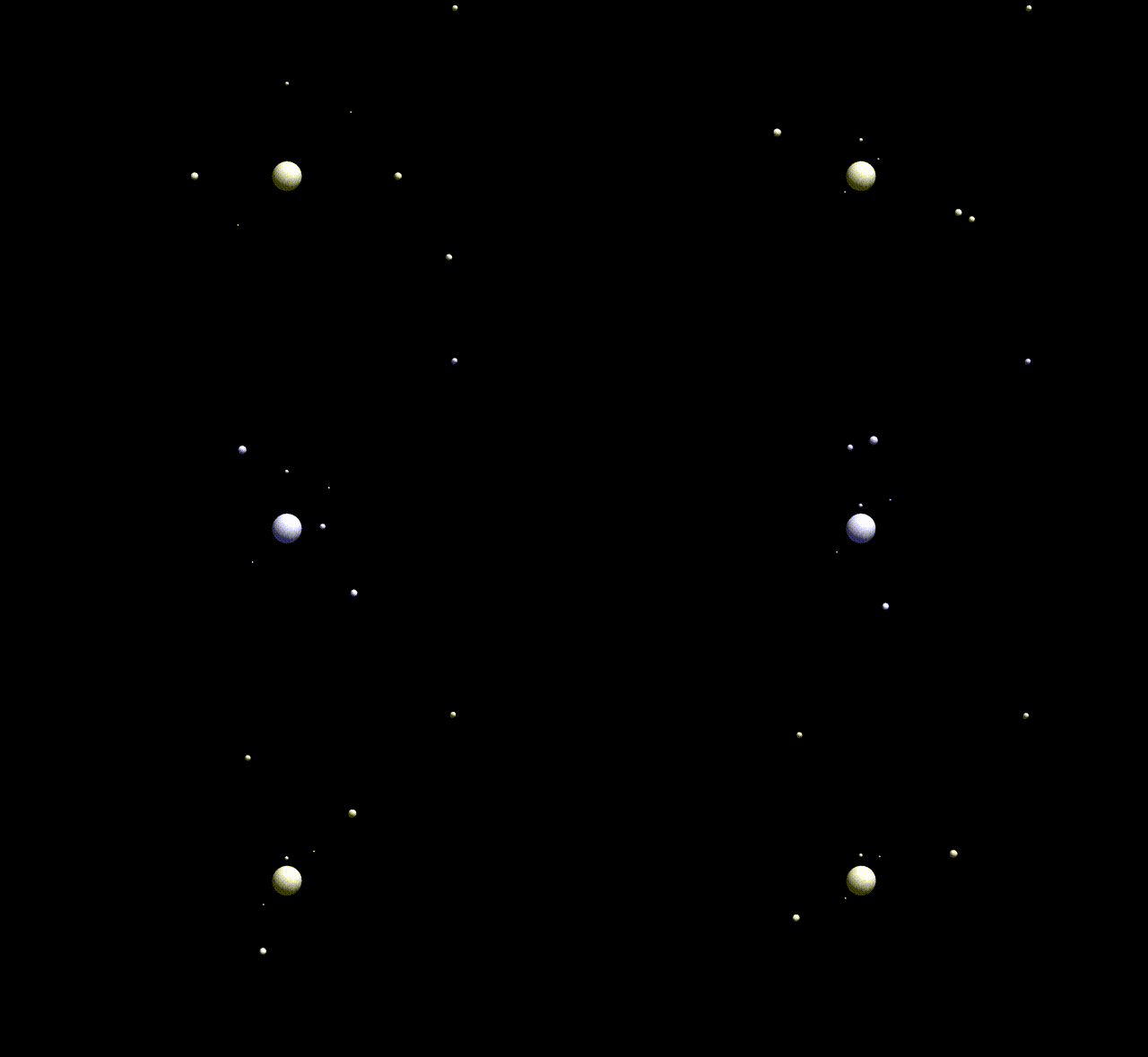
⚠️ This is a GIF preview. Hence some stuttering or quality loss. Click the GIF to see a short demo video including GUI!
- The code is work in progress
- Currently only tested and built in Linux Ubuntu
CHANGELOG.mddocuments current features and development steps- Built with C++, OpenGL, GLFW, Imgui, Implot
The simulation uses a direct N-body approach where every pair of bodies interacts gravitationally, resulting in O(N²) force evaluations per frame. This is the main bottleneck when scaling to larger body counts.
- Newton's third law: Each pair is evaluated once instead of twice, halving the number of force computations.
Parallelizing the force loop across CPU cores is the obvious next step, but it comes with a tradeoff. The Newton's third law optimization requires both bodies in a pair to be updated simultaneously, which introduces write conflicts between threads. The clean alternative is to give each body its own independent loop over all others: Safe to parallelize, but at the cost of redundant (2x) force evaluations.
Whether this tradeoff is worthwhile depends on the number of bodies and available cores:
| Bodies | Parallel worth it? |
|---|---|
| < 100 | No — thread overhead dominates |
| ~100–200 | Marginal — roughly break-even |
| 500+ | Yes — clear speedup |
| 1,000+ | Essential |
- Make it interactive --> enable manual configuration of initial conditions via GUI Window
- Improve physical accuracy and structure over time
- Make it cross-platform compatible
- Learn by building, not just reading
These are the required packages for building and running the simulation:
- Core OpenGL (libGL) — Mesa's implementation of the OpenGL specification
- OpenGL Utility Library (GLU) — A set of utilities for OpenGL
- GLFW Library — Window creation, OpenGL context, and input handling
- CMake — Cross-platform build system generator used to configure and build the project
sudo apt update
sudo apt install libgl1-mesa-dev libglu1-mesa-dev libglfw3-dev cmake
If apt is not available (e.g. on Arch or Fedora), use your distribution’s package manager instead (like pacman or dnf).
To install required dependencies on macOS, you can use Homebrew, the macOS package manager. Once Homebrew is installed, install GLFW:
brew install glfw cmakeOpenGL is already included with macOS as a system framework (OpenGL.framework), so no additional OpenGL installation is required.
Build the project:
# Create and enter the build directory
mkdir build && cd build

# Configure the build system (only to be repeated after major changes like new dependencies or files)
cmake ..

# Compile the project
cmake --build .
Run the simulation:
# With default scene file
./GravitySim ../scene.json

# Or with a custom scene file (e.g. from an API or script)
./GravitySim /path/to/custom_scene.json
If no argument is given and no scene.json is found, the simulation falls back to a built-in default scene.
Latfoo