插入
local t = {}
t.x = 1
查找
local t = {}
print(t.x)
获取长度
local t = {1, 2, 3}
print(#t)
迭代
local t = {1, 2, 3}
for k, v in pairs(t) do
	print(k, v)
end
在 Lua 实现中,Table 实际上由两部分构成:
- Array
- Hash Table
首先看一下源码中的结构(lobject.h):
typedef union TKey {
  struct {
    TValuefields;
    int next;  /* for chaining (offset for next node) */
  } nk; /* next key */
  TValue tvk; /* key */
} TKey;

/*
** hash table里的节点
 */
typedef struct Node {
  TValue i_val;
  TKey i_key;
} Node;


typedef struct Table {
  CommonHeader;
  lu_byte flags;  /* 1<<p means tagmethod(p) is not present */
  lu_byte lsizenode;
  unsigned int sizearray;
  TValue *array;
  Node *node;
  Node *lastfree;  /* any free position is before this position */
  struct Table *metatable;
  GCObject *gclist;
} Table;
捡几个主要的字段说:
nk
Hash Table 中用到闭散列,也就是发生冲突的节点存储在表的另一个槽内,由 nk 指向下一个节点;其中的 next 是根据当前节点的偏移,可正可负;
sizearray,lsizenode
Array 的大小和 Hash Table 的大小,由于哈希表的大小一定为 2 的整数次幂,所以这里的 lsizenode 表示的是幂次,而不是实际大小;
array,node
Array 和 Hash Table;
lastfree
用于指向 Hash Table 中的空闲位置;
flags
位图,每一位代表的是一个元方法类型,可快速判断当前 table 是否有某个元方法。
获取 key 的 value 并设置;key 不存在则创建新 key。
插入操作主要是通过 settableProtected(lvm.c) 宏完成的操作。
/* same for 'luaV_settable' */
#define settableProtected(L,t,k,v) { const TValue *slot; \
  if (!luaV_fastset(L,t,k,slot,luaH_get,v)) \
    Protect(luaV_finishset(L,t,k,v,slot)); }
luaV_fastset 方法会从 table 中获取 key 是否存在,存在则这是 value 的值;否则,执行 luaV_finishset,如果 t 是 table 类型,则会创建一个新 key 并设置 value;如果 t 不是 table 类型,那就从 t 中获取元方法 __newindex 并执行对应的操作;
这种情况下,会判断给定的 key 是 string 还是 number,string后面会讲到,单说number。
首先,判断 key 在不在 array 的区间中,如果在,则直接对 array 操作;
否则,从 Hash Table 中获取 key 对应的 value 信息,如果 value ~= nil,说明 Hash Table 存在此 key,则直接对 Hash Table 操作;
key 既不在 array 中也不在 Hash Table 中,那么就需要执行 luaH_newKey 创建一个新 key。
/*
** inserts a new key into a hash table; first, check whether key's main
** position is free. If not, check whether colliding node is in its main
** position or not: if it is not, move colliding node to an empty place and
** put new key in its main position; otherwise (colliding node is in its main
** position), new key goes to an empty position.
*/
TValue *luaH_newkey (lua_State *L, Table *t, const TValue *key) {
  Node *mp;
  TValue aux;
  if (ttisnil(key)) luaG_runerror(L, "table index is nil");
  else if (ttisfloat(key)) {
    lua_Integer k;
    if (luaV_tointeger(key, &k, 0)) {  /* index is int? */
      setivalue(&aux, k);
      key = &aux;  /* insert it as an integer */
    }
    else if (luai_numisnan(fltvalue(key)))
      luaG_runerror(L, "table index is NaN");
  }
  mp = mainposition(t, key); // 获取key的mainposition
  if (!ttisnil(gval(mp)) || isdummy(mp)) {  /* main position is taken? */
    Node *othern;
    Node *f = getfreepos(t);  /* get a free place */
    if (f == NULL) {  /* cannot find a free place? */
      rehash(L, t, key);  /* grow table */
      /* whatever called 'newkey' takes care of TM cache */
      return luaH_set(L, t, key);  /* insert key into grown table */
    }
    lua_assert(!isdummy(f));
    othern = mainposition(t, gkey(mp));
    if (othern != mp) {  /* is colliding node out of its main position? */
      /* yes; move colliding node into free position */
      while (othern + gnext(othern) != mp)  /* find previous */
        othern += gnext(othern);
      gnext(othern) = cast_int(f - othern);  /* rechain to point to 'f' */
      *f = *mp;  /* copy colliding node into free pos. (mp->next also goes) */
      if (gnext(mp) != 0) { //
        gnext(f) += cast_int(mp - f);  /* correct 'next' */
        gnext(mp) = 0;  /* now 'mp' is free */
      }
      setnilvalue(gval(mp));
    }
    else {  /* colliding node is in its own main position */
      /* new node will go into free position */
      if (gnext(mp) != 0)
        gnext(f) = cast_int((mp + gnext(mp)) - f);  /* chain new position */
      else lua_assert(gnext(f) == 0);
      gnext(mp) = cast_int(f - mp);
      mp = f;
    }
  }
  setnodekey(L, &mp->i_key, key);
  luaC_barrierback(L, t, key);
  lua_assert(ttisnil(gval(mp)));
  return gval(mp);
}
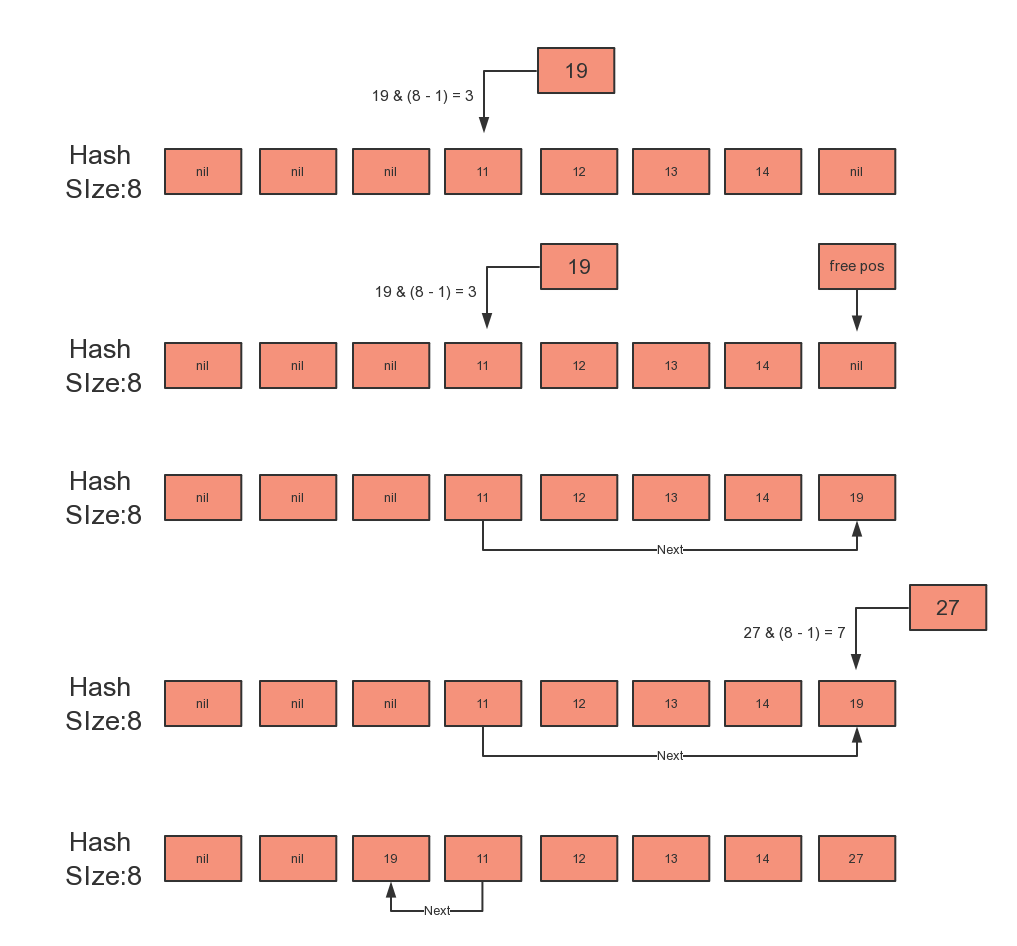
luaH_newkey是对 Hash Table 添加 一个新 key 的操作并返回对应的 value。Table 使用闭散列表,发生冲突时会写入空闲的位置并链到冲突链表的最后面。
向 Hash Table 中插入及冲突处理过程如下:
当 Hash Table 没有空余位置时会出发 rehash 操作。rehash 的主要工作是统计当前 table 中到底有多少有效键值对,以及决定数组部分需要开辟多少空间。 其原则是最终数组部分的利用率需要超过 50%。如果 array 中的有效元素过少或者但是需要的空间较大(例如在下标 1、2、100 处存在三个元素,则没必要开辟 100 的空间存放),则会相应调整 array 的尺寸,并把多余的元素放到 Hash Table 中,已达到较高的空间利用率。
例如:
local t = {1, 2, nil, nil, 5} -- 1
t.x = 1  -- 2
在table t 创建时,会把所有元素放置到 array 中,并设置 sizearray = 5,lsizenode = 0;
接下来对 t 创建了一个新的key x,所以会对 Hash Table 进行 rehash 以容纳所有的 key-value 类型;
rehash 过程中也会对 array 进行 resize,根据现有的大小会调整为8,之后发现有效元素只有3个(1、2、5),没超过 50% 使用率,所以会设置 sizearray = 4 并且将超出的元素 5 放到 Hash Table中;同理,收缩后发现有效元素(1、2)还是没超过 50% 利用率,设置 sizearray = 2;
最终,sizearray = 2,array 中存放1、2,lsizenode = 1,Hash Table 中存放 5、x;
t = {1, nil, nil, 4, 5}
print(#t)

t = {1, 2, 3, nil, nil}
print(#t)

t = {1, 2, nil, 4, nil}
print(#t)

t = {1, nil, 2, 3, 4}
t[100]=100
t.x=1
print(#t)
获取长度是通过 luaH_getn 方法实现的(ltable.c):
/*
** Try to find a boundary in table 't'. A 'boundary' is an integer index
** such that t[i] is non-nil and t[i+1] is nil (and 0 if t[1] is nil).
*/
int luaH_getn (Table *t) {
  unsigned int j = t->sizearray;
  if (j > 0 && ttisnil(&t->array[j - 1])) {
    /* there is a boundary in the array part: (binary) search for it */
    unsigned int i = 0;
    while (j - i > 1) {
      unsigned int m = (i+j)/2;
      if (ttisnil(&t->array[m - 1])) j = m;
      else i = m;
    }
    return i;
  }
  /* else must find a boundary in hash part */
  else if (isdummy(t->node))  /* hash part is empty? */
    return j;  /* that is easy... */
  else return unbound_search(t, j);
}
此方法有三个分支判断:
- 1 . 如果 sizearray 大于0,并且 array 的最后一个元素是 nil,则从[0 - sizearray]二分查找 值不是 nil 但是后一个值是 nil 的位置,直接返回。
例如对
t = {1, 2, nil, 4, nil}取长度,过程如下:
- 左边界
i = 0,右边界j = 5,array[(i + j) / 2] != nil,所以令i = (i + j) / 2;
- 左边界
i = 2,右边界j = 5,array[(i + j) / 2] == nil,所以令j = (i + j) / 2;
- 左边界
i = 2,右边界j = 3,i 和 j 已相邻,返回 i 的值2;
-
2 . 如果 sizearry 小于0 或者 最后一个元素不是nil,则判断 Hash Table 是否是假的数据,如果是,则直接返回 sizearray。
-
3 . 前两个条件都不满足,则执行
unbound_search。在unbound_search,会从 Hash Table 中从 sizearray + 1 开始查找空元素,每次步进为2次幂;找到后进行第一步二分查找边界值,并返回。 -
例如对
t = {1, nil, 3, 4, 5}; t.x = 1;取长度,过程如下:
- 暂定左边界
i = sizearray = 4,j = sizearray + 1 = 5,node[j] ~= nil,所以令j *= 2;
node[10] == nil,所以确定右边界j = 10;
- 二分查找,最后确定
i = 5并返回;
下面给出上方的答案:
> t = {1, nil, nil, 4, 5}
> print(#t)
5

> t = {1, 2, 3, nil, nil}
> print(#t)
3

> t = {1, 2, nil, 4, nil}
> print(#t)
2

> t = {1, nil, 2, 3, 4}
> t[100]=100
> t.x=1
> print(#t)
5
结论:在不确定的情况下最好用 table.count 或者自定义 __len 方法。
Lua 提供了一个 next 方法,传入上一个键,返回下一个键值对,而 pairs 也是用的这个方法,也就是luaH_next(ltable.c)。
int luaH_next (lua_State *L, Table *t, StkId key) {
  unsigned int i = findindex(L, t, key);  /* find original element */
  for (; i < t->sizearray; i++) {  /* try first array part */
    if (!ttisnil(&t->array[i])) {  /* a non-nil value? */
      setivalue(key, i + 1);
      setobj2s(L, key+1, &t->array[i]);
      return 1;
    }
  }
  for (i -= t->sizearray; cast_int(i) < sizenode(t); i++) {  /* hash part */
    if (!ttisnil(gval(gnode(t, i)))) {  /* a non-nil value? */
      setobj2s(L, key, gkey(gnode(t, i)));
      setobj2s(L, key+1, gval(gnode(t, i)));
      return 1;
    }
  }
  return 0;  /* no more elements */
}
它尝试在 array 中获取下一个值,当超出 array 部分后,则检索 Hash Table 中的位置。
而对键的预先操作是在 findinex 中完成的,如果给定的键是nil,返回0,否则,会在 array 和 Hash Table 中查找并返回相应的值。
/*
** returns the index of a 'key' for table traversals. First goes all
** elements in the array part, then elements in the hash part. The
** beginning of a traversal is signaled by 0.
*/
static unsigned int findindex (lua_State *L, Table *t, StkId key) {
  unsigned int i;
  if (ttisnil(key)) return 0;  /* first iteration */
  i = arrayindex(key);
  if (i != 0 && i <= t->sizearray)  /* is 'key' inside array part? */
    return i;  /* yes; that's the index */
  else {
    int nx;
    Node *n = mainposition(t, key);
    for (;;) {  /* check whether 'key' is somewhere in the chain */
      /* key may be dead already, but it is ok to use it in 'next' */
      if (luaV_rawequalobj(gkey(n), key) ||
            (ttisdeadkey(gkey(n)) && iscollectable(key) &&
             deadvalue(gkey(n)) == gcvalue(key))) {
        i = cast_int(n - gnode(t, 0));  /* key index in hash table */
        /* hash elements are numbered after array ones */
        return (i + 1) + t->sizearray;
      }
      nx = gnext(n);
      if (nx == 0)
        luaG_runerror(L, "invalid key to 'next'");  /* key not found */
      else n += nx;
    }
  }
}
ipairs 是通过 lua_geti 方法根据给定的 int 类型键查找,当遇到 nil 后停止,控制循环的代码在 lvm.c 中,后面的章节会讲到。
LUA_API int lua_geti (lua_State *L, int idx, lua_Integer n) {
  StkId t;
  const TValue *slot;
  lua_lock(L);
  t = index2addr(L, idx);
  if (luaV_fastget(L, t, n, slot, luaH_getint)) {
    setobj2s(L, L->top, slot);
    api_incr_top(L);
  }
  else {
    setivalue(L->top, n);
    api_incr_top(L);
    luaV_finishget(L, t, L->top - 1, L->top - 1, slot);
  }
  lua_unlock(L);
  return ttnov(L->top - 1);
}
由于很多操作都需要对元表的元方法进行访问,并非所有元表都提供了需要的元方法,所以查询一个元方法存不存在就需要特别的优化。
每个 Table 结构中都有一个 flags 字段,它用位的方式记录当前有哪些元方法。
下面是从 table 中获取指定 key 的值。
void luaV_finishget (lua_State *L, const TValue *t, TValue *key, StkId val,
                      const TValue *slot) {
  int loop;  /* counter to avoid infinite loops */
  const TValue *tm;  /* metamethod */
  for (loop = 0; loop < MAXTAGLOOP; loop++) { /* 处理MAXTAGLOOP(2000)层的元表 */
    if (slot == NULL) {  /* 't' is not a table? */
      lua_assert(!ttistable(t));
      tm = luaT_gettmbyobj(L, t, TM_INDEX);
      if (ttisnil(tm))
        luaG_typeerror(L, t, "index");  /* no metamethod */
      /* else will try the metamethod */
    }
    else {  /* 't' is a table */
      lua_assert(ttisnil(slot));
      tm = fasttm(L, hvalue(t)->metatable, TM_INDEX);  /* table's metamethod */
      if (tm == NULL) {  /* no metamethod? */
        setnilvalue(val);  /* result is nil */
        return;
      }
      /* else will try the metamethod */
    }
    if (ttisfunction(tm)) {  /* is metamethod a function? */
      luaT_callTM(L, tm, t, key, val, 1);  /* call it */
      return;
    }
    t = tm;  /* else try to access 'tm[key]' */
    if (luaV_fastget(L,t,key,slot,luaH_get)) {  /* fast track? */
      setobj2s(L, val, slot);  /* done */
      return;
    }
    /* else repeat (tail call 'luaV_finishget') */
  }
  luaG_runerror(L, "'__index' chain too long; possible loop");
}
luaV_finishget 一般是在 table 中直接获取 key 不存在时的后续步骤。如果 table 中没有,则从 metatable 中查找__index元方法,如果__index存在并且是 function,则调用 luaT_callTM 执行 __index 方法。否则将 metatable 按照同样的方法执行。注意,层次深度定义为宏 MAXTAGLOOP(1000)。
void luaT_callTM (lua_State *L, const TValue *f, const TValue *p1,
                  const TValue *p2, TValue *p3, int hasres) {
  ptrdiff_t result = savestack(L, p3);
  StkId func = L->top;
  setobj2s(L, func, f);  /* push function (assume EXTRA_STACK) */
  setobj2s(L, func + 1, p1);  /* 1st argument */
  setobj2s(L, func + 2, p2);  /* 2nd argument */
  L->top += 3;
  if (!hasres)  /* no result? 'p3' is third argument */
    setobj2s(L, L->top++, p3);  /* 3rd argument */
  /* metamethod may yield only when called from Lua code */
  if (isLua(L->ci))
    luaD_call(L, func, hasres);
  else
    luaD_callnoyield(L, func, hasres);
  if (hasres) {  /* if has result, move it to its place */
    p3 = restorestack(L, result);
    setobjs2s(L, p3, --L->top);
  }
}
所有元方法的参数都是 table、key,并把结果返回。